
Anthropic is cracking down on third-party tools that piggyback on Claude Pro and Max subscriptions. Cline, Roo Code, OpenClaw, and other AI coding tools are getting blocked, rate-limited, or shut out entirely.
If you've built your workflow around one of these tools, you're now facing a choice: switch models, pay API rates, or find an alternative that Anthropic won't block.
WoterClip doesn't have this problem. Not because Anthropic gave it a pass – but because of how it's built. WoterClip is a Claude Code plugin. It runs inside Claude Code, not outside it. That distinction is everything.
What Anthropic is actually blocking
Let's be specific about what's happening. Anthropic isn't blocking AI coding tools in general. They're blocking tools that use consumer subscription credentials to make API-scale requests through endpoints that were designed for the claude.ai web interface.
Here's what that looks like technically:
- Cline and Roo Code are VS Code extensions that connect to Claude through your Pro/Max subscription credentials. They send requests that look like API calls but route through consumer endpoints.
- OpenClaw is a proxy layer that explicitly facilitates using consumer subscriptions with third-party tools.
- Various browser extensions and alternative UIs that intercept or reuse claude.ai session tokens.
Anthropic's position is straightforward: Claude Pro and Max subscriptions are licensed for use through Anthropic's own applications. That means claude.ai, the Claude mobile apps, and Claude Code. Third-party tools routing requests through consumer credentials are unauthorized.
The enforcement is technical – Anthropic detects non-standard request patterns, blocks automated access from consumer sessions, and updates authentication to prevent credential sharing with third-party clients.
Why Cline and Roo Code are vulnerable
The architecture of tools like Cline creates an inherent platform risk. Here's why:
They're external applications. Cline is a VS Code extension that connects to Claude. It's a separate application making requests against Anthropic's infrastructure using your credentials. From Anthropic's perspective, this is a third-party client accessing consumer endpoints – exactly the pattern they're blocking.
They proxy consumer credentials. When you connect Cline to your Claude Pro account, your subscription credentials are being used by software Anthropic didn't build and doesn't control. This is the core ToS violation.
They consume API-scale compute at consumer prices. A heavy Cline user might generate thousands of requests per day – context loads, code completions, multi-file edits. That's API-tier usage at $20/month (Pro) pricing. The economics don't work for Anthropic.
They have no formal relationship with Anthropic. Cline isn't an official integration. There's no partnership agreement, no API contract, no sanctioned access. It's a third-party tool exploiting consumer access patterns.
This isn't a Cline-specific problem. Any tool built on the "borrow consumer credentials" model faces the same risk. The model provider can shut it down at any time.
How WoterClip is architecturally different
WoterClip doesn't connect to Claude. It doesn't make API calls. It doesn't use your subscription credentials. It doesn't even know your credentials exist.
WoterClip is a Claude Code plugin – a collection of YAML configuration files, markdown persona definitions, and skill definitions that extend what Claude Code can do. When you run WoterClip, you're running Claude Code. The compute, the authentication, the request routing – it's all Claude Code, Anthropic's own product.
Here's the architecture comparison:
| Cline / Roo Code | WoterClip | |
|---|---|---|
| What it is | External VS Code extension | Claude Code plugin (config files) |
| Authentication | Borrows your consumer credentials | None – uses your existing Claude Code session |
| Request routing | Sends requests to Claude endpoints | Doesn't send requests – Claude Code does |
| Compute model | API-scale requests at consumer rates | Same as typing prompts in Claude Code |
| Anthropic's view | Unauthorized third-party access | First-party tool usage |
| Block risk | High – actively being blocked | None – you're using Claude Code as designed |
The key insight: WoterClip is to Claude Code what a VS Code extension is to VS Code. It extends the tool's capabilities without bypassing its access controls.
What a Claude Code plugin actually is
If you haven't worked with the Claude Code plugin system, here's what WoterClip looks like on disk:
.woterclip/
  config.yaml          # Routing rules and settings
  personas/
    orchestrator/
      SOUL.md           # Persona identity and behavior
      TOOLS.md          # Available tools and constraints
    backend/
      SOUL.md
    frontend/
      SOUL.md
    content/
      SOUL.md
    ...21 personas total
That's it. There's no server. No database. No API client. No credential management. No separate process.
WoterClip's "orchestration layer" is Linear – a project management tool most teams already use. Issues come in through Linear, WoterClip's orchestrator persona routes them to the right specialist persona, and Claude Code executes the work using its native tools (Bash, Read, Write, Edit, MCP servers).
Everything runs through Claude Code's own permission system. If Claude Code can do it, WoterClip can do it. If Claude Code can't, WoterClip can't either. There's no privilege escalation, no credential borrowing, no unauthorized access.
What this means for the AI coding tool ecosystem
Anthropic's crackdown isn't arbitrary. It follows a predictable pattern that every platform eventually reaches:
- Open access – early days, anyone can build on top of consumer interfaces
- Growth – third-party tools get popular, driving significant compute load
- Economics – the gap between consumer pricing and actual compute costs becomes unsustainable
- Enforcement – the platform blocks unauthorized access and points developers to paid API plans
We've seen this with every major platform – Twitter's API lockdown, Reddit's API pricing changes, OpenAI's tightening of ChatGPT Plus access patterns.
The lesson for developers building on AI models: your tool's architecture determines your platform risk.
If you build as an external client that borrows credentials, you're one policy change away from breaking. If you build as a native extension of the platform's own tools, you're aligned with the platform's interests.
Claude Code's plugin system is Anthropic's official extensibility layer. Building on it means you're extending Anthropic's product, not competing with it. That's the difference between a sanctioned extension and an unauthorized client.
Should you switch from Cline to WoterClip?
They solve different problems. Cline is an inline coding assistant – it helps you write code in your editor. WoterClip is an agent orchestration system – it manages multiple AI personas that work through Linear issues autonomously.
But if you're using Cline for autonomous coding tasks and you're worried about getting blocked, the Claude Code plugin ecosystem is where the durable tools will live. WoterClip, along with other Claude Code plugins, runs inside the platform Anthropic controls and supports.
For autonomous agent workflows specifically – where you want AI to pick up tasks, do the work, and report back without babysitting – WoterClip's architecture is purpose-built. 21 personas, persona-based routing, heartbeat cycles, escalation chains, all running inside Claude Code.
For a deeper look at how WoterClip works, check out the launch post.
FAQ
Why is Anthropic blocking Cline and Roo Code?
Anthropic is blocking third-party tools that use Claude Pro and Max consumer subscription credentials to make API-scale requests. These tools route requests through consumer endpoints without authorization, consuming significant compute at consumer pricing. Anthropic's terms of service limit consumer subscriptions to use through Anthropic's own applications.
Will WoterClip get blocked by Anthropic?
No. WoterClip is a Claude Code plugin – it runs inside Claude Code, Anthropic's own product. It doesn't make API calls, doesn't borrow credentials, and doesn't access any endpoints independently. Using WoterClip is the same as using Claude Code, which is an authorized Anthropic application.
What is a Claude Code plugin?
A Claude Code plugin is a collection of configuration files (YAML, markdown, and optionally scripts) that extends Claude Code's capabilities. Plugins can add custom commands, skills, agents, and hooks. They run within Claude Code's process and permission system, not as separate applications.
Can Cline users switch to Claude Code plugins?
Yes, but they serve different purposes. Cline is an inline code assistant in VS Code. Claude Code plugins extend Claude Code's CLI and agent capabilities. For autonomous agent workflows, Claude Code plugins like WoterClip offer a more durable architecture that won't be affected by third-party access restrictions.
Is this just an Anthropic problem or do other AI providers do this too?
Most AI providers eventually restrict unauthorized third-party access to consumer subscriptions. OpenAI has tightened ChatGPT Plus access patterns. This is a standard platform lifecycle – open access, growth, economics pressure, then enforcement. Building on official extensibility layers (like Claude Code plugins) avoids this cycle.
What is WoterClip's architecture?
WoterClip is a Claude Code plugin with a YAML config file and 21 markdown persona definitions. It uses Linear as an external control plane for task management. Issues flow in through Linear, an orchestrator persona routes them, and specialist personas execute the work using Claude Code's native tools. No separate server, database, or API client required.
How many personas does WoterClip support?
WoterClip ships with 21 personas covering engineering (backend, frontend, infra, QA), marketing (content, SEO, social, email, paid acquisition), business (sales, bizdev, RevOps), and management (CEO, orchestrator). You can add custom personas by creating a new directory with SOUL.md and TOOLS.md files.
Is WoterClip open source?
Yes. WoterClip is an open-source Claude Code plugin. The source code and documentation are available on GitHub.
Stop guessing. Score your first workflow.
Score one workflow in about five minutes. Nine questions, a grade, and the specific gap holding it back - no call required.
Related Posts
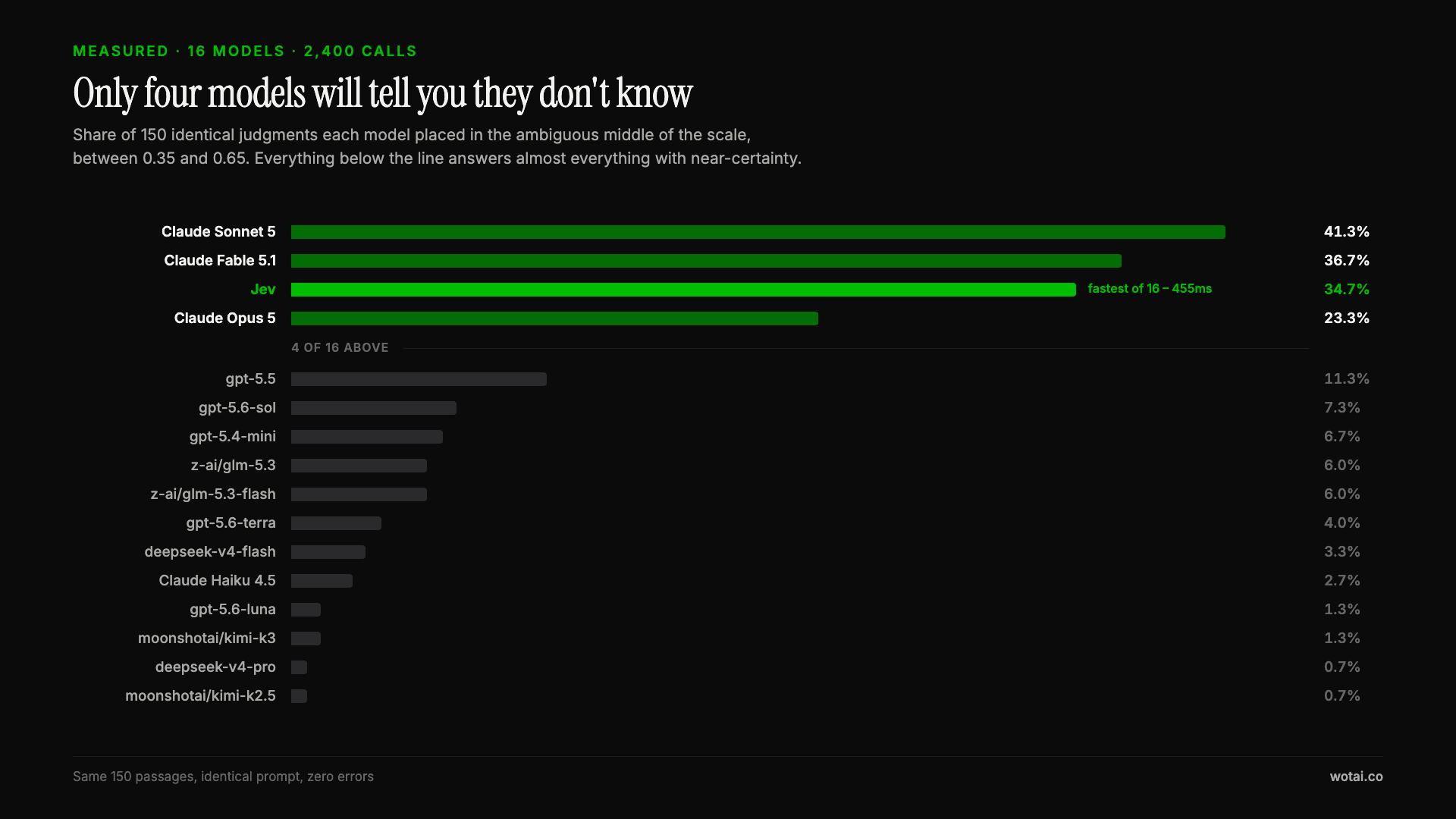
Jev is the only sub-second model that will tell you it doesn't know
Sixteen models on the same 150 passages, plus two more tasks. Only four of the sixteen will say they are unsure, and Jev is the only one of those four that answers in under a second.

AGENTS.md vs CLAUDE.md: which file your agent actually reads
Both files in one repo, measured: load order, token cost, and which one wins when they disagree. Every guide explains the difference; this one runs the test.

Compound engineering vs Superpowers: what each one installs
Both Claude Code plugins installed and measured: 14 skills against 33, one SessionStart hook against none, and the six skills that collide when you run both.