Claude Design vs Open Design: should you buy a design tool, or teach your CLI?
Last updated: April 29, 2026
TL;DR
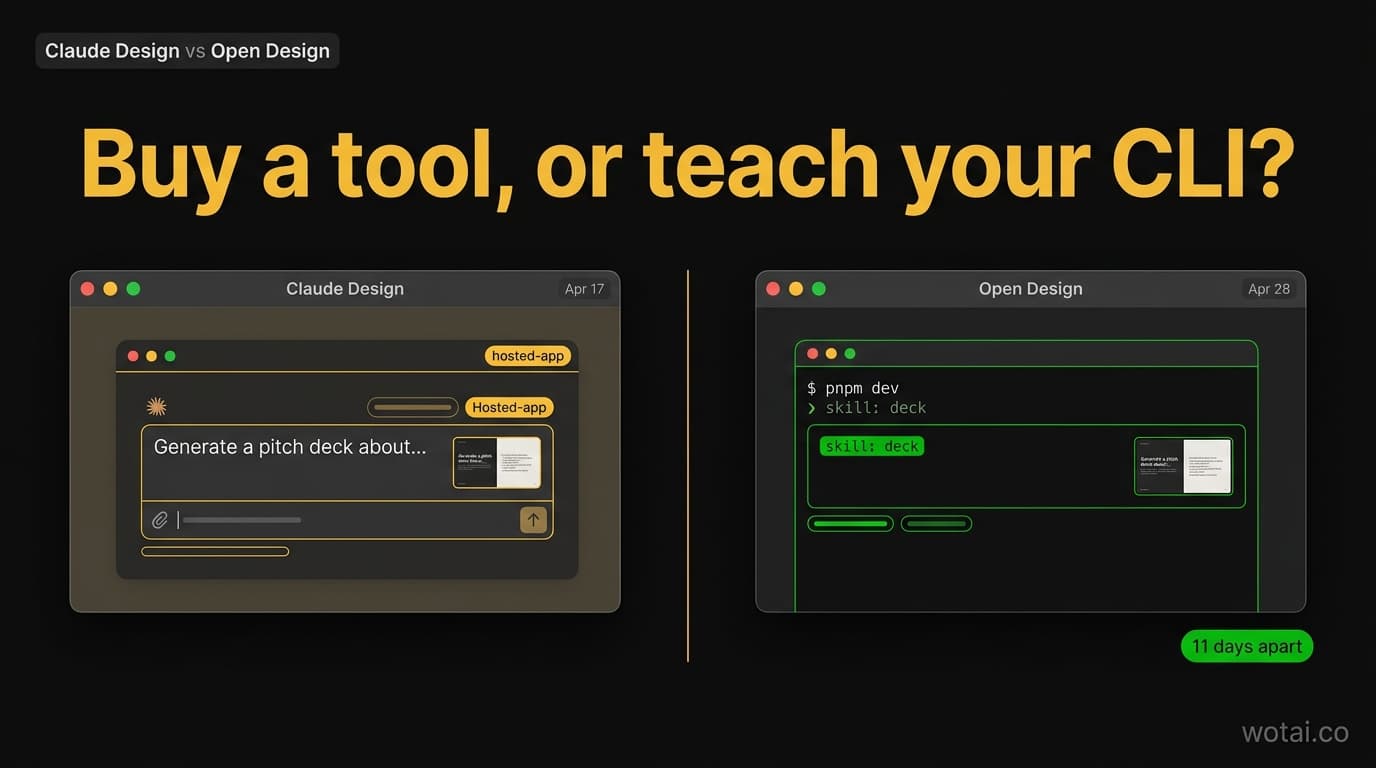
Anthropic launched Claude Design on April 17, 2026 – an Opus 4.7-powered design tool that converts prompts into prototypes, decks, and one-pagers. Eleven days later, Open Design shipped as an open-source clone with 71 brand-grade design systems (Linear, Stripe, Vercel, Notion, Apple) and BYOK support for Claude Code, Cursor, Codex, and any other coding agent you already run. The fork tells you the design-tool category got commoditized in two weeks. The real question isn't "which tool" – it's whether you want a hosted product with deep design-system integration, or a skill bundle that turns the CLI you already pay for into a design engine.
The 11-day fork
Anthropic shipped Claude Design on April 17. The Anthropic Labs team called it "an experimental product that lets you create visuals like prototypes, slides, one-pagers, and more using Claude." It runs on Opus 4.7, exports to PDF / URL / PPTX / Canva, and is available in research preview to Claude Pro, Max, Team, and Enterprise subscribers.
On April 28 – eleven days later – the nexu-io team published Open Design. Same artifact-first design loop. Apache 2.0. Local-first. 1,500+ GitHub stars in days. The README's headline: "the open-source alternative to Claude Design. Local-first, web-deployable, BYOK."
That gap is the story. The artifact-first design loop – detect intent, pick a skill and design system, chat to refine, parse the artifact, preview, save – is now commoditized. The category Anthropic launched lasted eleven days as proprietary surface area before an open-source equivalent existed. Two products entering the same lane in two weeks doesn't mean the category is dying. It means the bar for what counts as "a design tool" just shifted from a hosted SaaS to a skill bundle that runs on whichever coding agent you already pay for.
That shift changes how you should evaluate this. The right question stopped being "which tool ships better prototypes." It became "which model fits the stack you already own?"
What is Claude Design
Claude Design is Anthropic's experimental AI design product, launched April 17, 2026 and powered by Opus 4.7. It generates prototypes, presentation decks, one-pagers, and mockups from natural-language prompts. It reads your team's codebase and design files to apply your visual style automatically, supports iterative refinement through direct edits or follow-up prompts, and exports to PDF, URL, PPTX, or Canva (where outputs become fully editable). Available in research preview for Claude Pro ($20/mo), Max ($100-200/mo), Team, and Enterprise plans. Aimed at founders and product managers without design backgrounds.
What is Open Design
Open Design is an open-source local-first replica of Claude Design, published April 28, 2026 by the nexu-io team under Apache 2.0. It ships with 19 composable skills (prototypes, decks, dashboards, mobile apps, templates), 71 brand-grade design systems (Linear, Stripe, Vercel, Notion, Apple, and more), an interactive discovery form, sandboxed iframe preview, and HTML/PDF/PPTX/ZIP export. The key architectural difference: Open Design doesn't bundle an agent – it wires into whichever coding CLI you already run (Claude Code, Cursor, Codex, Gemini CLI, OpenCode, Qwen) and uses that as the design engine. BYOK at every layer. Runs pnpm dev locally or deploys to Vercel.
The economic split
The headline number: if you already pay for Claude Code, Open Design costs you $0 incremental. If you don't, Claude Design adds $20/mo (Pro) to $200/mo (Max) on top of whatever you already spend on tooling.
That's not a cheap shot at Anthropic. It's a real architectural difference in how the products are billed:
- Claude Design is a hosted product. Anthropic pays the inference cost on Opus 4.7 every time you generate. They recoup that through your subscription. The pricing is sane.
- Open Design is a skill bundle. The inference cost falls on whichever model you point your CLI at. If you're already running Claude Code Max, those generations are part of your existing token budget. If you're running Cursor or Codex, same idea on those plans.
The question isn't "is one cheaper" – the question is whether your existing tooling stack already has the headroom for design generation. For a builder running Claude Code Max ($200/mo, 4.5 billion tokens of monthly headroom according to actual usage data on the plan), the answer is yes. For a founder evaluating their first Anthropic plan and not yet paying for Claude Code, Claude Design's hosted Pro tier is probably the cleaner entry point.
Where each one wins
Honest evaluation, not partisan framing.
Claude Design wins on
- Design-system integration depth. It reads your codebase plus your existing design files and applies your visual style automatically. Open Design ships 71 prebuilt brand systems, but adapting to your specific design tokens and component library is where Claude Design's codebase-reading capability pays off.
- Hosted UX. No setup. No
pnpm dev. No managing a local SQLite database. Open it in Claude.ai and start generating. - Canva export. The output goes straight to Canva and becomes fully collaborative + editable. For teams already on Canva, that's a meaningful workflow shortcut.
- Lower technical floor. A founder or PM who can't run a Vite dev server can use Claude Design today. Open Design assumes you have a CLI agent already configured and running.
Open Design wins on
- 71 design systems vs proprietary. Linear, Stripe, Vercel, Notion, Apple, and more shipped on day one. If you want your output to look like a Linear-grade dashboard or a Stripe-grade landing page out of the box, Open Design has more starting points.
- No vendor lock-in. Apache 2.0 license, BYOK at every layer, deployable to your own Vercel project. Your design loop doesn't depend on Anthropic's continued investment in Claude Design as a product line.
- Runs on whatever CLI you already pay for. Claude Code, Cursor, Codex, Gemini CLI, OpenCode, Qwen. The model you trust most for code is now the model designing your visuals.
- Customizable skills. Drop a folder into
skills/to add a new design type. The 19 shipped skills are a starting point, not a ceiling. - Local-first. Your design artifacts stay on your laptop until you choose to deploy them. For client work under NDA, that matters.
Both
Both produce HTML, PDF, and PPTX exports. Both let you iterate through chat. Both apply design systems – the difference is whose. Both are early – Claude Design is research preview, Open Design has no tagged releases yet. Don't bet your client deliverable on either being stable.
At-a-glance comparison
| Dimension | Claude Design | Open Design |
|---|---|---|
| Launched | April 17, 2026 | April 28, 2026 |
| License | Proprietary (Anthropic) | Apache 2.0 |
| Pricing | Bundled in Pro/Max/Team/Enterprise plans | Free; you pay your CLI's tokens |
| Underlying model | Opus 4.7 (fixed) | Whatever your CLI runs (Claude / GPT / Gemini / etc.) |
| Hosting | Hosted by Anthropic | Local-first; deployable to Vercel |
| Setup time | Open Claude.ai, start generating | Clone repo, pnpm dev, point at a CLI |
| Design systems | Reads your codebase + design files | 71 prebuilt (Linear, Stripe, Vercel, Notion, Apple, etc.) |
| Export formats | PDF, URL, PPTX, Canva | HTML, PDF, PPTX, ZIP |
| Skills | Built-in (proprietary) | 19 composable, drop-in extensible |
| Vendor lock-in | High (tied to Anthropic) | None (BYOK everywhere) |
| Best for | Founders/PMs without design backgrounds | Builders already running a coding CLI |
Who should pick which
Pick Claude Design if:
- You don't already pay for Claude Code or another coding CLI.
- You want a hosted product with zero setup.
- Canva is part of your team's design workflow and you need clean handoff.
- Your design system lives in your codebase and you want it auto-applied.
- You're a founder or PM whose comfort zone stops at "open a web app and prompt."
Pick Open Design if:
- You're already on Claude Code Max or another agent CLI with token headroom.
- You're doing client work and need local-first artifact storage.
- You want one of the 71 prebuilt design systems (Linear, Stripe, Vercel, Notion, Apple) as your starting point.
- You want to add custom skills (industry-specific design types your work needs).
- You want to deploy your own design loop to Vercel and not depend on Anthropic continuing to invest in Claude Design as a product.
Pick both, in different contexts:
- Claude Design for early-stage exploration with non-technical collaborators.
- Open Design for production design work inside your existing dev workflow.
The bigger story: design tools just became skills
Here's what the 11-day fork actually means.
A few years ago, "design tool" was a category – Figma, Sketch, Adobe XD, vertical SaaS apps with their own pricing, their own learning curves, their own export workflows. The category had moats: the canvas, the component libraries, the team collaboration, the file format.
Claude Design tried to extend that category into AI-native generation. Open Design demonstrated, eleven days later, that the AI-native version of the category isn't a category – it's a skill bundle that drops into the agent runtime you already pay for.
This is the same pattern that played out with workflow automation, code review, content generation, and search. The vertical SaaS app shows up first to define the shape. Then an open-source equivalent shows up faster than anyone expected, demonstrating that the underlying capability was always portable. The hosted product survives only if it offers something the skill bundle can't replicate – and "design system depth" plus "zero-setup hosted UX" is a real moat for some users, but it's not the entire category.
The practical implication: if you're a builder who already pays for an agent CLI, your default assumption should shift from "I need a separate design tool" to "what skill bundle does my CLI need to design?" Sometimes the answer is still "buy the hosted product because the design-system integration is worth it." But the default has flipped.
That's the real news. Not which tool wins. The category itself shifted definition.
What this means for your stack right now
Three concrete moves, depending on where you are:
-
If you already pay for Claude Code or Cursor: Spend an afternoon with Open Design. Clone the repo, point it at your CLI, generate a deck for an actual project. You'll know within a few prompts whether the 71-design-system library covers your needs. If yes, you've added a design tool to your stack at zero incremental cost.
-
If you don't pay for any agent CLI yet and need design output: Claude Design at $20/mo is the cleanest entry point. You don't need to set up a development environment. You don't need to manage a local database. You generate, refine, export.
-
If you're already running both options: Use Claude Design for collaborative work with non-technical stakeholders (the Canva export is the unlock). Use Open Design for production work inside your dev workflow.
The honest answer: try both. They're both early enough that committing to one before testing the other is premature. Use Open Design's repo to start the local-first version, and Claude Design's research preview for the hosted version. The decision will surface from actual use within a week.
If you're following along with how AI tooling decisions like this play out in production, the WotAI community on Skool has 700+ builders comparing notes weekly. Free to join.
FAQ
What is Claude Design and when did it launch?
Claude Design is Anthropic's AI design tool, launched April 17, 2026. It's powered by Opus 4.7 and generates prototypes, presentation decks, one-pagers, and mockups from natural-language prompts. It reads a team's codebase and design files to apply visual style automatically, and exports to PDF, URL, PPTX, or Canva. It's available in research preview for Claude Pro ($20/mo), Max, Team, and Enterprise subscribers.
What is Open Design?
Open Design is an open-source clone of Claude Design, published April 28, 2026 by the nexu-io team under Apache 2.0. It ships with 19 composable skills, 71 brand-grade design systems (Linear, Stripe, Vercel, Notion, Apple, and others), and runs on any coding CLI you already use (Claude Code, Cursor, Codex, Gemini CLI, OpenCode, Qwen). It deploys locally with pnpm dev or to Vercel.
How is Open Design different from Claude Design?
The architectural difference: Claude Design is a hosted product running on Opus 4.7 with proprietary design systems. Open Design is a skill bundle that wires into whichever coding CLI you already pay for, with 71 prebuilt brand-grade design systems shipped on day one. Claude Design optimizes for hosted UX and codebase-reading design-system integration. Open Design optimizes for vendor independence, local-first storage, and reuse of existing CLI subscriptions.
Do I need a Claude Code subscription to use Open Design?
No, but having one (or another agent CLI like Cursor, Codex, Gemini CLI, OpenCode, or Qwen) is the point. Open Design is BYOK – you bring your own coding agent, and Open Design uses it as the design engine. Without a CLI configured, there's no model to run generations. With a CLI you already pay for, design generations come out of that existing token budget at no incremental cost.
Can Open Design read my company's design system like Claude Design does?
Not the same way. Claude Design reads your codebase and design files to extract and apply your specific design tokens and component library automatically. Open Design ships 71 prebuilt brand-grade design systems (Linear, Stripe, Vercel, Notion, Apple, and others) as starting points, but adapting to a specific custom design system requires customizing one of those starting points or adding a new skill. For deep custom-design-system integration, Claude Design is more turnkey today.
Which one is better for non-technical users?
Claude Design. It's a hosted product – you open it in your browser and start generating. Open Design assumes you have a coding CLI configured, can run pnpm dev, and are comfortable in a development environment. For founders, product managers, and other non-technical stakeholders, Claude Design's setup floor is lower.
How much does each one cost?
Claude Design is bundled into Anthropic's existing plans: Claude Pro ($20/mo), Max ($100/mo or $200/mo), Team, and Enterprise. There's no separate Claude Design pricing. Open Design is free under Apache 2.0 – you pay only for whichever CLI you connect to it (which you presumably already pay for if you have a coding agent in your stack).
Can I use both together?
Yes, and it's a reasonable approach. Use Claude Design for early-stage exploration with non-technical collaborators (the Canva export streamlines handoff to non-technical team members). Use Open Design for production design work that lives inside your existing development workflow. Different tools for different surfaces of the same workflow.
Is Open Design production-ready?
It's early. Open Design was published April 28, 2026, has no tagged releases yet, and is at roughly 1,500 GitHub stars. The architecture is sound and the artifact-first design loop runs end to end. Treat it the same way you'd treat Claude Design's research preview: useful for exploration, not yet a guaranteed-stable foundation for client deliverables. Both products are evolving weekly.
What does it mean for AI tooling pricing?
It means the "vertical SaaS app" model for AI-native tools is on shorter timers than vendors expect. Open Design demonstrated that the artifact-first design loop is portable to any agent runtime. The same pattern will play out across other AI-native categories – workflow generation, code review, content tooling. Hosted products survive when they offer integration depth or hosted UX a skill bundle can't replicate. Otherwise, the open-source equivalent shows up within weeks.
Where can I read more about each tool?
For Claude Design, see Anthropic's official announcement. For Open Design, the GitHub repository has the full README, skill conventions, and contribution guide. For ongoing analysis of how AI tooling decisions play out in production, the WotAI Skool community has 700+ builders sharing real-world notes weekly.
Stop guessing. Score your first workflow.
Score one workflow in about five minutes. Nine questions, a grade, and the specific gap holding it back - no call required.
Related Posts
AGENTS.md vs CLAUDE.md: which file your agent actually reads
Both files in one repo, measured: load order, token cost, and which one wins when they disagree. Every guide explains the difference; this one runs the test.
Compound engineering vs Superpowers: what each one installs
Both Claude Code plugins installed and measured: 14 skills against 33, one SessionStart hook against none, and the six skills that collide when you run both.
Claude Code Video Editing: How I Stopped Touching the Timeline
Claude Code can drive a real video timeline over MCP – reading project state, placing clips, styling captions – on a project file you can open and inspect. Here's the setup that turns an agent into an editing team, the four-layer specification that makes it work, and the decisions that stay human.