Open Design, 4 weeks in: should an SMB owner touch it yet?
Last updated: May 26, 2026
TL;DR
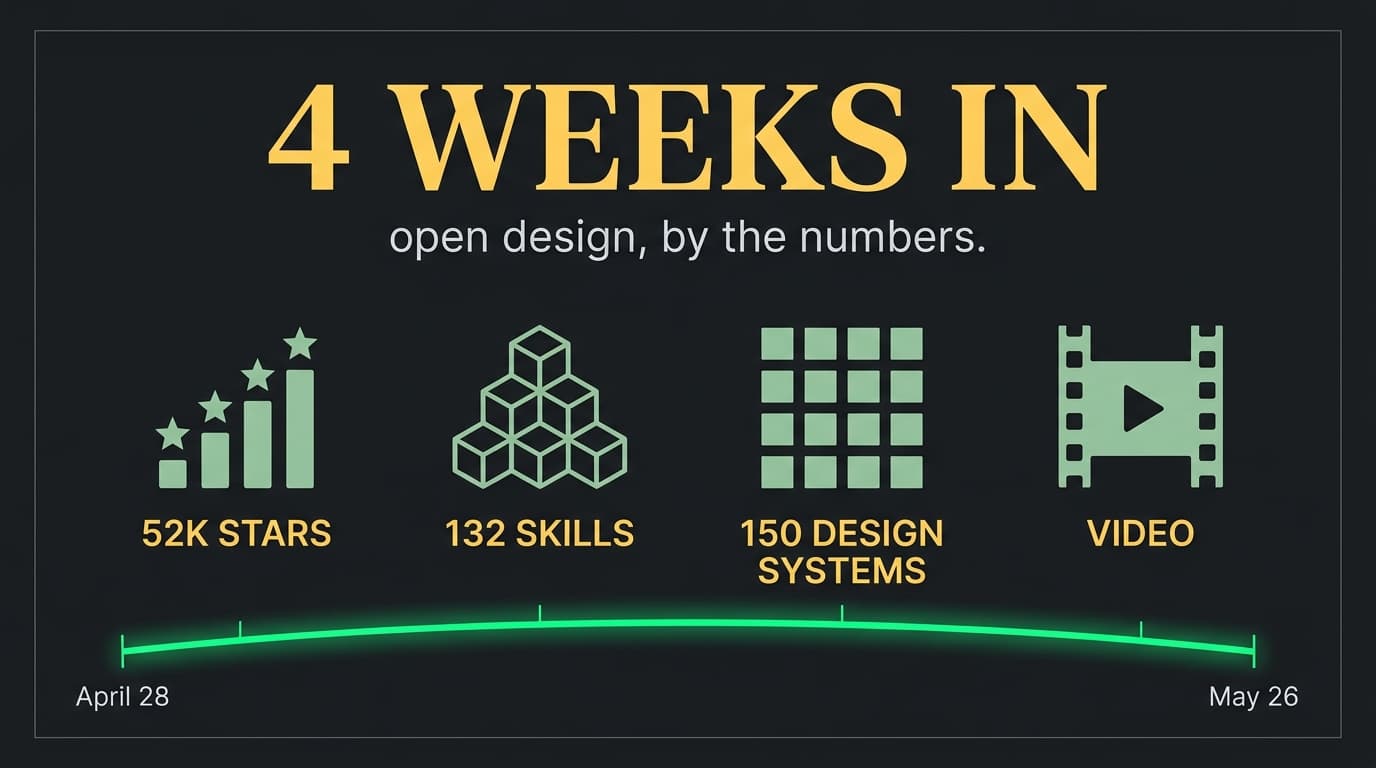
Open Design had 1,500 GitHub stars when it launched on April 28. As of this morning it's at 52,718. Eight stable releases in 28 days. Skills jumped from 19 to 132. Design systems jumped from 71 to 150. It does video and motion graphics now, runs on 16 different coding agents, and just shipped an import path that takes a Claude Design export ZIP and turns it into an Open Design project. Anthropic, in the same four weeks, has shipped nothing publicly. If you write code or you have someone who does, Open Design is the call. If you're solo and non-technical, stick with Claude Design's hosted version for now.
What is Open Design
Open Design is the open-source, local-first alternative to Anthropic's Claude Design. You type a brief, it generates an artifact – web prototype, deck, mobile app mockup, dashboard, editorial page, and now (as of v0.7) video and motion graphics. The thing that makes it interesting is what runs the generation. Claude Design lives on Anthropic's infrastructure and only runs on Claude Opus 4.7. Open Design runs on whichever coding-agent CLI is already on your laptop – Claude Code, Codex, Cursor Agent, Gemini CLI, OpenCode, GitHub Copilot CLI, or any of 10 others.
I wrote the launch-week comparison here. Most of it is still true. But the version of Open Design that exists today is meaningfully different from the one I reviewed 28 days ago. So this is the update.
What's changed since April 28
The team shipped 8 stable releases in 28 days. Pace that out – that's a release every three and a half days. One of them, v0.4.0, is tagged "DO NOT USE" in the release notes, which I respect more than most version histories. Honest beats clean.
GitHub stars went from 1,500 to 52,718. Forks: 5,989. There's a Discord community now. The README ships in 13 languages.
Skills went from 19 to 132. The new ones cover saas-landing pages, mobile-app mockups, dashboards, social carousels, magazine-poster layouts, sprite animation. Deck modes for guizang-ppt, simple-deck, replit-deck, weekly-update. A long tail of operational stuff like kanban-board, team-okrs, finance-report, hr-onboarding, invoice. The picker now groups them by scenario instead of dumping the full list – design, marketing, operation, engineering, product, finance, hr, sale, personal.
Design systems went from 71 to 150. The 71 original brand-grade systems (Linear, Stripe, Vercel, Notion, Apple) got joined by 57 community-contributed skills from the awesome-design-skills repo, plus more product systems – Airbnb, Tesla, Cursor, Supabase, Figma, Anthropic, Xiaohongshu.
The CLI list went from 6 to 16. New ones: Devin for Terminal, Cursor Agent, Qoder CLI, GitHub Copilot CLI, Hermes, Kimi CLI, Pi, Kiro CLI, Kilo, Mistral Vibe CLI, DeepSeek TUI. The daemon scans your PATH and auto-detects whatever you have installed. Swap engines with one click.
The big scope additions are media generation. v0.7 added images (gpt-image-2 from Azure / OpenAI), video (Seedance 2.0 from ByteDance, 15-second text-to-video and image-to-video), and motion graphics (HyperFrames, HTML-to-MP4 product reveals and kinetic typography). There's a 93-prompt gallery split across the three engines – 43 image, 39 video, 11 motion graphics – so you have starting points instead of staring at a blank field.
Translation: Open Design isn't a "design prototype tool" anymore. It's a multi-format artifact generator running on the agent you trust most for code.
A few smaller things worth mentioning:
A BYOK proxy at /api/proxy/{anthropic,openai,azure,google,ollama,senseaudio}/stream if you don't have any CLI configured. Paste your API key, point at any of those providers, get the same loop.
A packaged Electron desktop app for macOS (Apple Silicon and Intel) and Windows (x64). Linux AppImage exists but is gated.
A Claude Design import endpoint at /api/import/claude-design that takes a Claude Design export ZIP and turns it into a real Open Design project. Anthropic shipped the lock-in. Nexu-io shipped the escape hatch.
Meanwhile, Anthropic's Claude Design has shipped nothing publicly since the April 17 launch. Still research preview, still Opus 4.7, still bundled into Pro / Max / Team / Enterprise. That's not a knock – research-preview cadence is fine. It's just the contrast.
Should an SMB owner touch it yet?
The April 29 verdict was "depends if you already pay for Claude Code." Four weeks later the answer is sharper:
| Operator profile | Verdict | Why |
|---|---|---|
| Technical solo founder (writes code daily) | Yes | 16-CLI auto-detection means whichever agent you trust is the engine. Install is 10 minutes. |
| Non-technical solo operator | Not yet | pnpm tools-dev is still the friction. Use Claude Design's hosted product, or wait for the desktop installer to mature past v0.8-preview. |
| Agency owner with a builder on staff | Yes | Builder handles setup. Team gets a multi-format artifact pipeline (web / deck / video) for a single token budget. |
| SMB consultant doing one-off client deliverables | Mixed | Editable handoff still belongs to Claude Design's Canva export. Sandboxed web artifacts and motion-graphics videos are where Open Design's v0.7 just changed the math. |
The biggest shift since launch is the consultant row. Four weeks ago, "video generation" wasn't on the feature list. Today, a brief gets you a 15-second MP4 product reveal in the same surface you'd use for a web mockup. If you've been pricing motion-graphics work to outside vendors, that's a real margin move.
If you want the longer freelance-designer-vs-tool cost math, that's a separate post landing in this series.
If you do try it: the 10-minute install path
Three steps. Install a CLI (I run Claude Code – it already handles my commits, pulls, and PRs, so I'd rather it also drive my design loop). Clone nexu-io/open-design, run pnpm tools-dev from the repo root. Open the local web UI, type a brief, pick a skill and a direction.
The full setup walkthrough is here — covers the common install gotchas reported in the project's GitHub Discussions and Discord.
What I'm watching for in June
Three things I'd want to see before flipping the non-technical-operator verdict from "not yet" to "yes."
A stable v1.0 release. Eight stable releases in 28 days is fast; a v1.0 says the desktop installer is no longer the rough edge.
The Claude Design import path proving out on real exports. The endpoint exists. If it preserves brand systems and component references cleanly, the migration story writes itself.
HyperFrames in the wild. Motion graphics is the biggest scope addition in months. If real SMB-grade motion content starts shipping from Open Design in the next 30 days, the case study writes itself for July.
Frequently asked questions
Is Open Design free to use in May 2026?
Yes. Apache 2.0 license, free to clone and run locally. You pay only for whichever CLI you connect it to (Claude Code, Cursor, Codex, etc.) – which you presumably already pay for if you have a coding agent in your stack. The BYOK proxy lets you point at any OpenAI-compatible provider with your own API key.
Does Open Design have an official release version yet?
Yes. As of May 26, 2026, Open Design has shipped 8 stable releases (v0.1.0 through v0.8.0). The latest stable is v0.8.0, with a v0.8.0-preview iterating on the main branch. One release (v0.4.0) is tagged "DO NOT USE" – the team flagged it themselves rather than silently re-shipping.
Can I use Open Design without a Claude Code subscription?
Yes. Open Design auto-detects 16 different coding-agent CLIs on your PATH, including Codex, Cursor Agent, Gemini CLI, OpenCode, Qwen, and GitHub Copilot CLI. If you don't have any CLI installed, the BYOK proxy lets you connect directly to Anthropic, OpenAI, Azure, Google Gemini, Ollama Cloud, or SenseAudio with your own API key.
Should a non-technical small business owner try Open Design today?
Not yet. Open Design still requires running pnpm tools-dev locally – which means Node, pnpm, and comfort with a terminal. The packaged Electron desktop installer at open-design.ai removes some of that friction but the underlying setup still requires a CLI to do the actual generation work. For non-technical SMB owners, Anthropic's hosted Claude Design is the cleaner entry point until the Electron app matures past v0.8-preview.
What design systems does Open Design ship with as of May 2026?
150 brand-grade design systems are included as of May 26, 2026. The core set covers Linear, Stripe, Vercel, Notion, Apple, Airbnb, Tesla, Cursor, Supabase, Figma, Anthropic, and Xiaohongshu, with 57 additional skills contributed from the awesome-design-skills community repository. Pick one at the entry view before typing your brief – the chosen design system determines the visual language of the output.
Is Open Design production-ready for client work?
Cautiously yes. Eight stable releases in four weeks is fast iteration, but the architecture has held. Real client work has shipped from Open Design (visible in the GitHub Discussions and Discord). Standard caveats: pin to a specific stable release before starting a client project, generate a backup export before each major edit session, and treat the v0.8.0-preview as separate from the production v0.8.0 path. Apache 2.0 license means you can fork and self-host if anything breaks.
If you run a small business and want the weekly write-up on which AI tools are actually worth your time, subscribe to the newsletter. Or come hang out with 760+ builders in the Skool community, where the threads on this stuff go deeper.
– Alex
Stop guessing. Score your first workflow.
Score one workflow in about five minutes. Nine questions, a grade, and the specific gap holding it back - no call required.
Related Posts
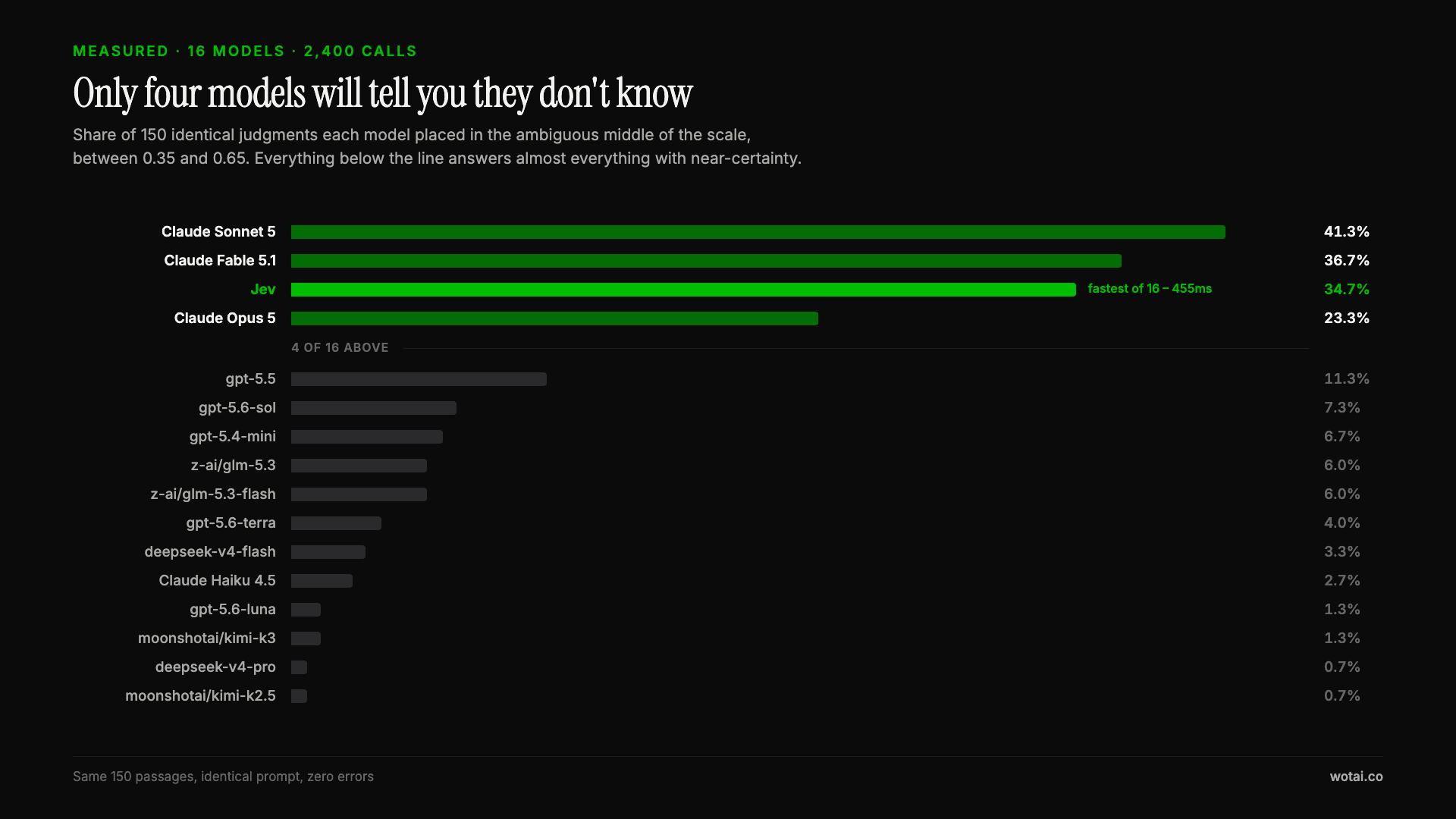
Jev is the only sub-second model that will tell you it doesn't know
Sixteen models on the same 150 passages, plus two more tasks. Only four of the sixteen will say they are unsure, and Jev is the only one of those four that answers in under a second.
AGENTS.md vs CLAUDE.md: which file your agent actually reads
Both files in one repo, measured: load order, token cost, and which one wins when they disagree. Every guide explains the difference; this one runs the test.
Compound engineering vs Superpowers: what each one installs
Both Claude Code plugins installed and measured: 14 skills against 33, one SessionStart hook against none, and the six skills that collide when you run both.