Last updated: May 29, 2026
Anthropic shipped Claude Opus 4.8 on May 28, and the benchmark scores are the least interesting part. They went up. They always go up.
What changed is what you can hand the model. With dynamic workflows in Claude Code, you give Claude a project-scale job and it plans the work, runs hundreds of agents in parallel to do it, and checks the results before they reach you. And Opus 4.8 itself is much less likely to let a flaw in its own code slip past – which is the thing that decides whether delegating real work is safe or just fast.
So here's what actually shipped, with the model's scorecard kept in its place.
TL;DR
- Dynamic workflows landed in Claude Code (research preview): plan once, run tens to hundreds of parallel subagents in one session, with results checked before they reach you. Jarred Sumner used it to port Bun from Zig to Rust – roughly 750,000 lines, 99.8% of the existing test suite passing, 11 days from first commit to merge.
- Opus 4.8 is about 4x less likely than 4.7 to let a flaw in its own code pass unremarked, and more willing to flag uncertainty. For work that runs unattended, that matters more than any score.
- Effort control arrived in claude.ai and Cowork; fast mode now runs on Opus 4.8 at a fraction of the old cost. Model id
claude-opus-4-8, same price as 4.7. - The benchmarks did improve – agentic terminal coding jumped 66.1% to 74.6%, the most relevant gain if an agent runs your git loop. Full table below.
- Latest Claude Code is 2.1.156 (May 29). Update before you lean on Opus 4.8.
- For n8n users: dynamic workflows is ephemeral and lives in the terminal. Flow builds persistent, visual n8n workflows you can inspect and hand to someone who never opens a CLI. Different lanes, both useful.
What actually changed in Claude Opus 4.8
The most important change in Opus 4.8 isn't something you'll see in a demo. It's that the model is around four times less likely than 4.7 to let a flaw in code it wrote pass unremarked, and it's more likely to tell you when it's uncertain instead of asserting confidently. When an agent runs unattended – commits, test runs, migrations – "catches its own mistakes and admits doubt" is the difference between delegation you trust and delegation you re-check by hand.
That reliability change is what makes the rest of the release usable. A faster, smarter model that quietly ships its own bugs isn't a coworker. One that flags them is.
Two practical controls came with it:
- Effort control in claude.ai and Cowork. Dial how hard the model thinks against how fast it answers. In Claude Code, Opus 4.8 defaults to high effort, with an
xhighsetting for the hardest tasks. Most work doesn't need maximum thinking, and now you can say so – which saves both time and tokens. - Fast mode on Opus 4.8, running at 2x the standard rate for about 2.5x the speed, a fraction of what the previous fast mode cost.
There's also a quieter API change worth knowing if you build on Anthropic: the Messages API now accepts system entries mid-conversation, so you can change instructions partway through without breaking the prompt cache. Model id is claude-opus-4-8, pricing is unchanged from 4.7, and it's live on all paid plans plus the Claude API, Amazon Bedrock, Google Vertex AI, and Microsoft Foundry today. (Anthropic announcement)
Dynamic workflows in Claude Code: tens to hundreds of subagents in one session
Dynamic workflows is the change that actually moves what Claude Code can take off your plate. It lets Claude plan a piece of work, then run tens to hundreds of parallel subagents to do it in a single session – with verification built in, so results are checked before they reach you. It shipped as a research preview the same day as Opus 4.8.
The proof point is concrete. Jarred Sumner used dynamic workflows to port Bun from Zig to Rust: roughly 750,000 lines of Rust, 99.8% of the existing test suite passing, and 11 days from first commit to merge. The existing test suite acted as its own check on the migration. That's not autocomplete. That's a coworker running a project-scale job.
There are two ways to start one:
- Ask Claude directly to create a workflow for a task.
- Turn on the
ultracodesetting from the effort menu, which sets effort toxhighand lets Claude decide when a workflow is the right tool.
You watch runs with the /workflows command. Dynamic workflows is available in the Claude Code CLI, Desktop app, and VS Code extension, on Max, Team, and Enterprise plans (admin-enabled), plus the API, Bedrock, Vertex, and Foundry.
One caution worth stating plainly: a dynamic workflow can burn substantially more tokens than a normal Claude Code session, because you're running many agents at once. The payoff is real on codebase-scale work. For a two-file change, it's overkill. (Dynamic workflows announcement, Claude Code workflows docs)
The benchmarks, briefly
The scores went up, and the table is worth a glance – just not the reason to care. Here's Opus 4.7 against 4.8:
| Benchmark | What it measures | Opus 4.7 | Opus 4.8 |
|---|---|---|---|
| SWE-Bench Pro | Agentic coding | 64.3% | 69.2% |
| Terminal-Bench 2.1 | Agentic terminal coding | 66.1% | 74.6% |
| OSWorld-Verified | Agentic computer use | 82.8% | 83.4% |
| GDPval-AA | Knowledge work | 1753 | 1890 |
| Humanity's Last Exam (no tools) | Multidisciplinary reasoning | 46.9% | 49.8% |
| Finance Agent v2 | Agentic financial analysis | 51.5% | 53.9% |
The one row that maps to real work is agentic terminal coding: 66.1% to 74.6%, an 8.5-point jump in a single release. If you've already handed your commit, push, and PR loop to Claude Code, that benchmark measures the work you no longer do by hand. The rest moved a little; this one moved a lot. Everything else in the table confirms the model is better – it isn't, on its own, the reason to switch.
The latest version of Claude Code (2.1.156)
The latest Claude Code is 2.1.156, released May 29 – a single hotfix that resolves an API error with Opus 4.8 where thinking blocks were being modified. It sits directly on top of 2.1.154, the May 28 release that carried the Opus 4.8 launch.
If you only read one changelog this week, read 2.1.154. The items that change how you work:
- Opus 4.8 support, defaulting to high effort, with
/effort xhighfor the hardest tasks. - Dynamic workflows (covered above), viewable with
/workflows. - The lean system prompt is now the default for every model except Haiku, Sonnet, and Opus 4.7 and earlier.
- Fewer interruptions. Claude now reserves multiple-choice prompts for decisions it genuinely can't make on its own, instead of asking when it already has enough context.
/simplifynow runs a cleanup-only review – reuse, simplification, efficiency – and applies the fixes./effortslider relabeled from "Speed" and "Intelligence" to "Faster" and "Smarter."- Background shell sessions in
claude agents: type! <command>to run a shell command as an attachable, detachable session. - Streaming tool execution is always on now, including on Bedrock, Vertex, and Foundry.
Anthropic's changelog is the source of truth. The short version: if you're more than a few versions behind, update before you lean on Opus 4.8, because 2.1.156 exists specifically to keep the new model from throwing API errors.
What Opus 4.8 and dynamic workflows mean for n8n users
Dynamic workflows and n8n solve workflow orchestration in two different lanes, and this release makes the boundary sharper, not blurrier. Dynamic workflows is ephemeral: it spins up agents for a session, does the job, and the orchestration evaporates when the session ends. It lives in the terminal and assumes you're a developer.
n8n sits in the other lane. The workflow is a persistent, visual graph you can open, inspect, version, and run on a schedule for months. A teammate who has never touched a CLI can look at it and understand what it does. When something breaks at 2 a.m., you have a graph to read, not a transcript to reconstruct.
That's the gap Flow fills. Flow's wizard generates validated n8n workflow JSON – real nodes, real connections, 70 to 99% complete on the first pass – that you export or deploy straight to your n8n instance. Anthropic just made "AI plans and orchestrates the work" a first-class idea for developers. Flow makes the durable, inspectable version of that idea available to the operators who run a business, not a codebase.
Pick by the job. A codebase-scale migration you'll run once, from a terminal? Dynamic workflows. A reporting pipeline, a lead-routing automation, or a content workflow that has to run reliably for the next year and be readable by a non-developer? That's an n8n graph, and Flow gets you there faster than prompting a chatbot for JSON. If you're an operator weighing where AI fits in your stack, our small-business guide is a better starting point than any benchmark table.
Should you move to Opus 4.8?
Yes, with one practical note. If you run Claude Code, update to 2.1.156 first – it exists to stop Opus 4.8 from throwing thinking-block API errors, so adopting the model on an older version is the slower path.
The two things you'll feel within a day are the reliability change and dynamic workflows. A model that flags its own flaws makes delegated work safer to leave alone; dynamic workflows is worth trying on a job that genuinely warrants tens of parallel agents – a migration, a broad refactor, a codebase-wide audit – and worth skipping for anything a single session handles cleanly, given the token cost. The benchmark gains are real, but they're the confirmation, not the headline.
Frequently asked questions
What is Claude Opus 4.8?
Claude Opus 4.8 is Anthropic's coding-and-agents model released May 28, 2026 (model id claude-opus-4-8). It improves on Opus 4.7 across coding, terminal work, computer use, reasoning, and knowledge work, and is about 4x less likely to let a flaw in its own code pass unremarked. Pricing is unchanged from 4.7.
How much better is Opus 4.8 than 4.7 at coding? Agentic coding on SWE-Bench Pro moved from 64.3% to 69.2%, and agentic terminal coding on Terminal-Bench 2.1 jumped from 66.1% to 74.6% – an 8.5-point gain. Terminal coding is the most relevant number if an agent already runs your git and test loop.
What are dynamic workflows in Claude Code? Dynamic workflows let Claude Code plan a task, then run tens to hundreds of parallel subagents in a single session, verifying results before they reach you. It shipped as a research preview on May 28, 2026, for codebase-scale work like large migrations and broad refactors.
How do I start a dynamic workflow?
Ask Claude directly to create a workflow for a task, or enable the ultracode setting from the effort menu, which sets effort to xhigh and lets Claude decide when to use one. View active runs with the /workflows command in the Claude Code CLI, Desktop, or VS Code extension.
What is the latest version of Claude Code? The latest version is 2.1.156, released May 29, 2026. It's a hotfix that resolves an Opus 4.8 API error caused by modified thinking blocks. It follows 2.1.154 (May 28), which added Opus 4.8 support, dynamic workflows, and fast mode on the new model.
Does Opus 4.8 cost more than Opus 4.7? No. Standard pricing is unchanged from Opus 4.7. Fast mode on Opus 4.8 runs at 2x the standard rate for about 2.5x the speed, which is a fraction of what the previous fast mode cost.
Which plans have dynamic workflows? Dynamic workflows is available in research preview on Max, Team, and Enterprise plans (Enterprise requires admin enablement), through the Claude Code CLI, Desktop app, and VS Code extension, plus the Claude API, Amazon Bedrock, Google Vertex AI, and Microsoft Foundry.
Do dynamic workflows replace n8n? No. Dynamic workflows is ephemeral, developer-facing orchestration inside Claude Code that ends with the session. n8n is a persistent, visual workflow you can inspect, version, and run on a schedule, readable by non-developers. They serve different jobs – pick by whether the automation needs to last and be readable, or just run once.
Should I update to Claude Code 2.1.156? Yes, especially if you plan to use Opus 4.8. 2.1.156 exists to fix an Opus 4.8 thinking-block API error, so updating before you adopt the model avoids a known failure. If you run dynamic workflows, you want a current version regardless.
Where to go from here
The running Claude Code release coverage on WotAI: 2.1.141 was the last big breakdown, and this is the Opus 4.8 chapter on top of it.
If you build workflows for a business rather than a codebase, Flow is the persistent, n8n-native counterpart to what dynamic workflows does in the terminal. And if you're working out where AI fits in a small business at all, start with the small-business guide.
The patterns we run around these features in real production work – background agents, parallel worktrees, workflow orchestration – live in the WotAI Skool community. 760+ builders, weekly calls.
Anthropic's Opus 4.8 announcement, the dynamic workflows post, and the Claude Code changelog are the primary sources. This is the version that pulls out the parts that change how you work.
Stop guessing. Score your first workflow.
Score one workflow in about five minutes. Nine questions, a grade, and the specific gap holding it back - no call required.
Related Posts
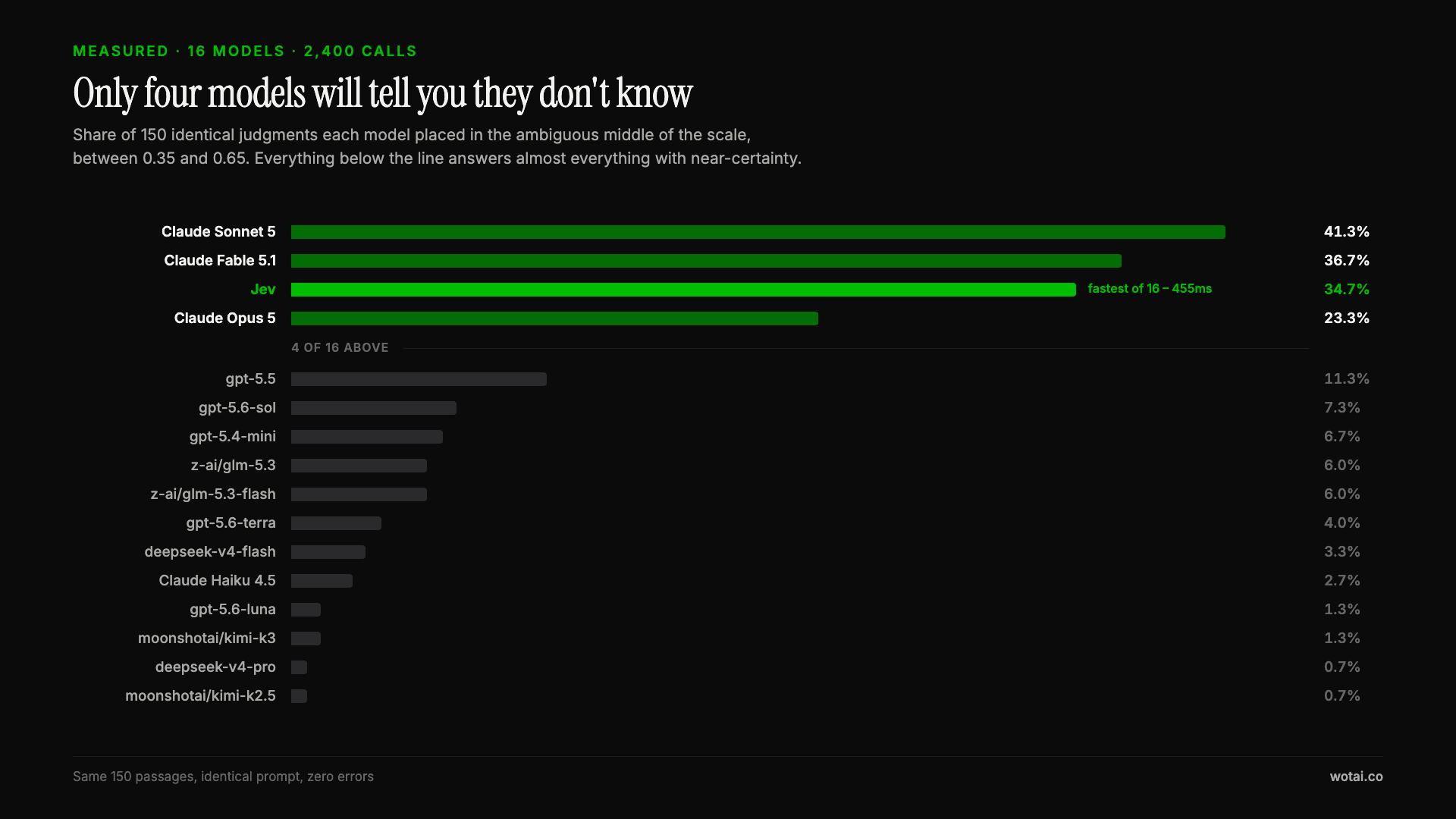
Jev is the only sub-second model that will tell you it doesn't know
Sixteen models on the same 150 passages, plus two more tasks. Only four of the sixteen will say they are unsure, and Jev is the only one of those four that answers in under a second.

AGENTS.md vs CLAUDE.md: which file your agent actually reads
Both files in one repo, measured: load order, token cost, and which one wins when they disagree. Every guide explains the difference; this one runs the test.

Compound engineering vs Superpowers: what each one installs
Both Claude Code plugins installed and measured: 14 skills against 33, one SessionStart hook against none, and the six skills that collide when you run both.