What is agent washing? (And why your n8n workflows are more honest than most "AI agents")
Every few years, the tech industry picks a new word and runs it into the ground.
First it was "cloud." Then "blockchain." Then "AI-powered." Now? It's "agents."
Open LinkedIn on any given Tuesday and you'll see it: "We're building AI agents for [thing that was already automated]." Scroll through Product Hunt and every other launch is an "autonomous AI agent" that, when you look under the hood, sends an email when a Zapier trigger fires.
This is agent washing. And if you're building real automation with tools like n8n, you're probably more honest about what your software does than 90% of the companies claiming to sell "AI agents."
What agent washing actually means
Agent washing is the practice of rebranding basic automation, simple chatbots, or scripted workflows as sophisticated "AI agents" – without delivering any of the autonomy, reasoning, or adaptability that the term implies. Thoughtworks calls it "the era of agentwashing," where the term "AI agent" is being overused, overhyped, and often misapplied.
The name borrows from "greenwashing" (companies exaggerating environmental claims) and "AI washing" (slapping "AI-powered" on products that barely use machine learning). Agent washing is the 2025-2026 version: take whatever you already built, call it an "agent," and watch your valuation climb.
Gartner estimates that only about 130 companies out of thousands claiming to build AI agents are actually building real ones. The rest? Chatbots with marketing budgets.
And the consequences aren't just annoying. Gartner also predicts that over 40% of agentic AI projects will be canceled by the end of 2027 - because the gap between what was promised and what was delivered will become impossible to ignore.
How to spot agent washing
A real AI agent has a few defining characteristics:
- Autonomous decision-making. It can evaluate a situation and choose a course of action without step-by-step instructions.
- Planning and reasoning. It can break complex tasks into subtasks and adapt when things go wrong.
- Tool use. It can interact with external systems, APIs, and databases on its own.
- Memory and context. It maintains state across interactions and learns from outcomes.
Now compare that to what most "AI agents" actually do:
- Run a pre-defined sequence of API calls
- Send a prompt to an LLM and return the response
- Trigger actions based on if/then rules
- Follow a flowchart someone designed in a no-code builder
That second list? That's automation. Good automation, sometimes. But it's not an agent. Calling it one is agent washing.
Why this matters to builders
If you're reading this, you probably build things. You wire up n8n workflows, connect APIs, design trigger-action sequences that solve real problems for real businesses.
And here's the thing that should make you feel good: a well-built deterministic workflow is more reliable, more predictable, and more valuable in production than most things calling themselves "AI agents" right now.
That's not a knock on AI. It's an observation about what actually works when money is on the line.
When a client needs their CRM updated every time a form is submitted, they don't need an "autonomous agent." They need a workflow that fires reliably, handles edge cases gracefully, and doesn't hallucinate a field mapping.
When an e-commerce business needs inventory synced across three platforms, they don't need "agentic AI." They need nodes connected in the right order with proper error handling.
The automation community has been solving these problems for years. The agent hype cycle didn't invent reliability - it just made people forget that reliability already existed.
The honesty spectrum
Not everything is binary. There's a spectrum between "pure deterministic workflow" and "fully autonomous agent," and most useful software lives somewhere in the middle.
Here's how I think about it:
Deterministic workflows (n8n, Make, Zapier): Every step is defined. Every path is predictable. You can look at the workflow, trace the logic, and know exactly what will happen. This is where most business automation should live.
AI-enhanced workflows: A deterministic workflow that uses an LLM at specific steps - for summarization, classification, or content generation. The workflow controls the flow; the AI handles the fuzzy parts. This is the sweet spot for most teams right now.
True AI agents: Software that can plan, reason, use tools, and adapt autonomously. These exist – Claude can use a computer, GPT can call functions, some research agents can navigate multi-step problems. But they're expensive, unpredictable, and require significant guardrails to run in production. As Capital One's engineering team notes, "for straightforward, rule-based tasks, workflows outperform AI agents by ensuring accuracy and efficiency."
Most "AI agent" products on the market today are actually in category one or two. They're workflows. And there's nothing wrong with that - unless you're lying about it.
Why n8n workflows are more honest
n8n is an open-source workflow automation platform. When you build something in n8n, you get a visual graph of exactly what happens: which nodes fire, in what order, with what data. You can inspect every connection, test every branch, and debug every failure.
There's no mystery. No "autonomous reasoning" you can't trace. No black box that might decide to do something different on Tuesday.
That transparency is a feature, not a limitation. When you hand a client an n8n workflow, you're handing them something they can:
- Inspect - every node is visible, every connection is traceable
- Modify - add a step, change a condition, swap an integration
- Debug - when something breaks, you can see exactly where and why
- Own - it runs on their infrastructure, with their data
Compare that to an "AI agent" SaaS where the logic is hidden behind a chat interface and you have no idea why it did what it did. Which one would you trust with your business?
The practical middle ground
Here's where I'll be direct about what we're building.
Flow doesn't claim to be an agent. It's an AI-powered tool that generates n8n workflow JSON. You describe what you need, Flow asks the right questions, and it produces a real, validated workflow with real n8n nodes and real connections.
The output is a workflow you can open, inspect, and modify. Not a black box. Not an "autonomous agent." A workflow - the most honest unit of automation there is.
We use AI where it makes sense (understanding your requirements, mapping them to the right nodes and configurations) and deterministic logic where it makes sense (validating the JSON, ensuring node connections are correct, checking that the workflow will actually run).
That's the middle ground most businesses actually need: AI to handle the creative part, deterministic systems to handle the execution.
What to ask before buying an "AI agent"
Next time someone pitches you an "AI agent," ask these questions:
- Can I see the workflow? If there's no way to inspect what the "agent" actually does, that's a red flag.
- What happens when it fails? Real agents fail unpredictably. If they can't explain the failure modes, they haven't thought about production.
- Is the AI doing the reasoning or the routing? If the AI just picks which pre-built path to follow, that's a workflow with an LLM classifier. Not an agent.
- Can I modify the logic? If you're locked into their abstraction with no way to adjust behavior, you're buying a black box.
- What does it do that a workflow can't? This is the real question. If the answer is "nothing, but with more marketing," you've found agent washing.
The hype will fade. The workflows won't.
Every hype cycle follows the same pattern: peak excitement, inevitable disappointment, and then the quiet period where real value gets built.
We're somewhere between peak excitement and disappointment for AI agents right now. The companies that survive will be the ones building things that actually work - not the ones with the best marketing.
And the builders who've been shipping real automation all along? They'll keep doing what they've been doing: connecting systems, moving data, solving problems. One workflow at a time.
No agent washing required.
FAQ
What is agent washing in AI? Agent washing is the practice of rebranding basic automation tools, chatbots, or scripted workflows as "AI agents" without delivering genuine autonomous reasoning, planning, or adaptability. The term follows the pattern of "greenwashing" and "AI washing."
How can you tell if a product is a real AI agent or agent washing? Real AI agents demonstrate autonomous decision-making, multi-step planning, tool use, and contextual memory. If the product follows pre-defined rules, runs scripted sequences, or just wraps an LLM call in a chat interface, it's likely a workflow being marketed as an agent.
Why are deterministic workflows more reliable than AI agents? Deterministic workflows follow defined paths with predictable outcomes. Every step is inspectable, debuggable, and modifiable. AI agents introduce non-determinism - they might choose different actions each time, making them harder to test, debug, and trust in production environments.
What is the difference between AI agents and workflow automation? Workflow automation follows pre-defined steps in a fixed sequence: trigger, action, condition, action. AI agents can autonomously plan, reason about goals, choose tools, and adapt their approach based on results. Most "AI agent" products today are actually closer to workflow automation.
Is n8n an AI agent platform? n8n is an open-source workflow automation platform, not an AI agent platform. It excels at deterministic, inspectable automation. You can integrate AI (like LLM nodes) into n8n workflows for specific tasks, but the workflow itself follows defined logic - which is a strength for production reliability.
What percentage of AI agents are actually real? Gartner estimates that only about 130 out of thousands of companies claiming to build AI agents are building genuinely agentic systems. The rest are rebranding existing automation, chatbots, or simple LLM wrappers as "agents."
Will AI agents replace workflow automation? Not for most business use cases. Deterministic workflows remain the best choice for tasks that need reliability, auditability, and predictability. AI agents are better suited for novel, unstructured problems where autonomy is worth the trade-off in predictability.
What is the AI hype cycle for agents? The AI agent hype cycle follows Gartner's typical pattern: a technology trigger (LLMs gaining tool use), peak of inflated expectations (every product becomes an "agent"), trough of disillusionment (40%+ of agentic projects canceled by 2027), and eventually a plateau of productivity where real use cases emerge.
Stop guessing. Score your first workflow.
Score one workflow in about five minutes. Nine questions, a grade, and the specific gap holding it back - no call required.
Related Posts
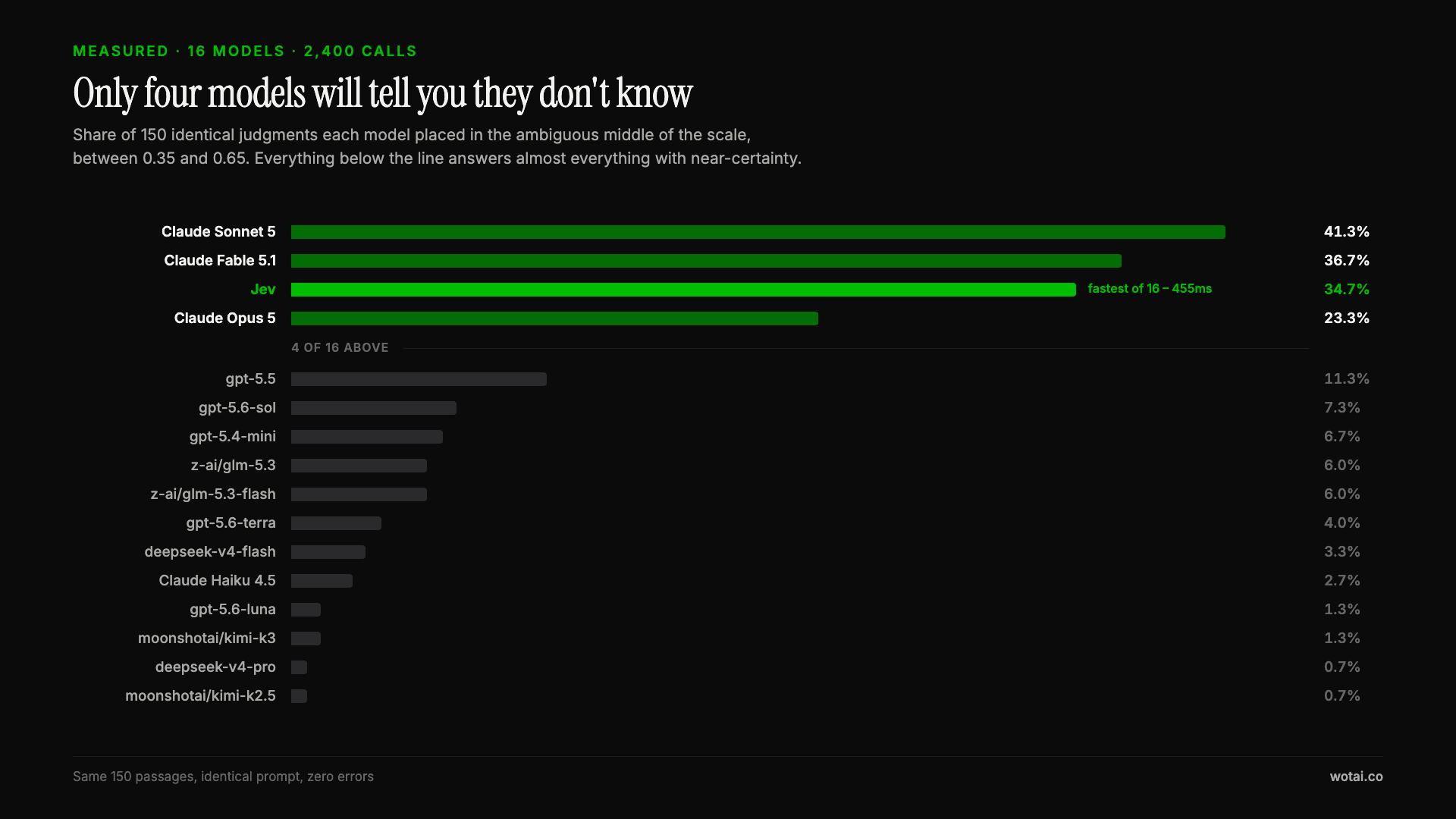
Jev is the only sub-second model that will tell you it doesn't know
Sixteen models on the same 150 passages, plus two more tasks. Only four of the sixteen will say they are unsure, and Jev is the only one of those four that answers in under a second.
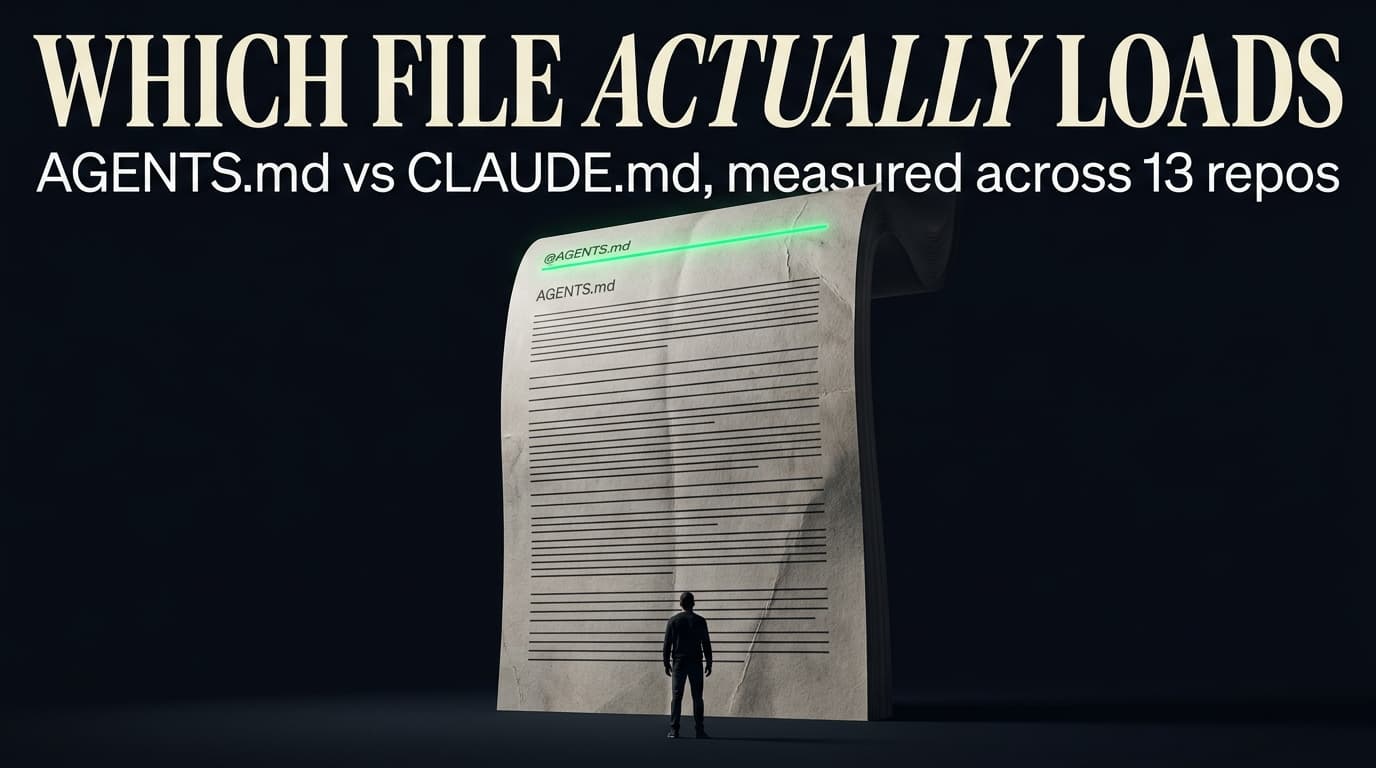
AGENTS.md vs CLAUDE.md: which file your agent actually reads
Both files in one repo, measured: load order, token cost, and which one wins when they disagree. Every guide explains the difference; this one runs the test.
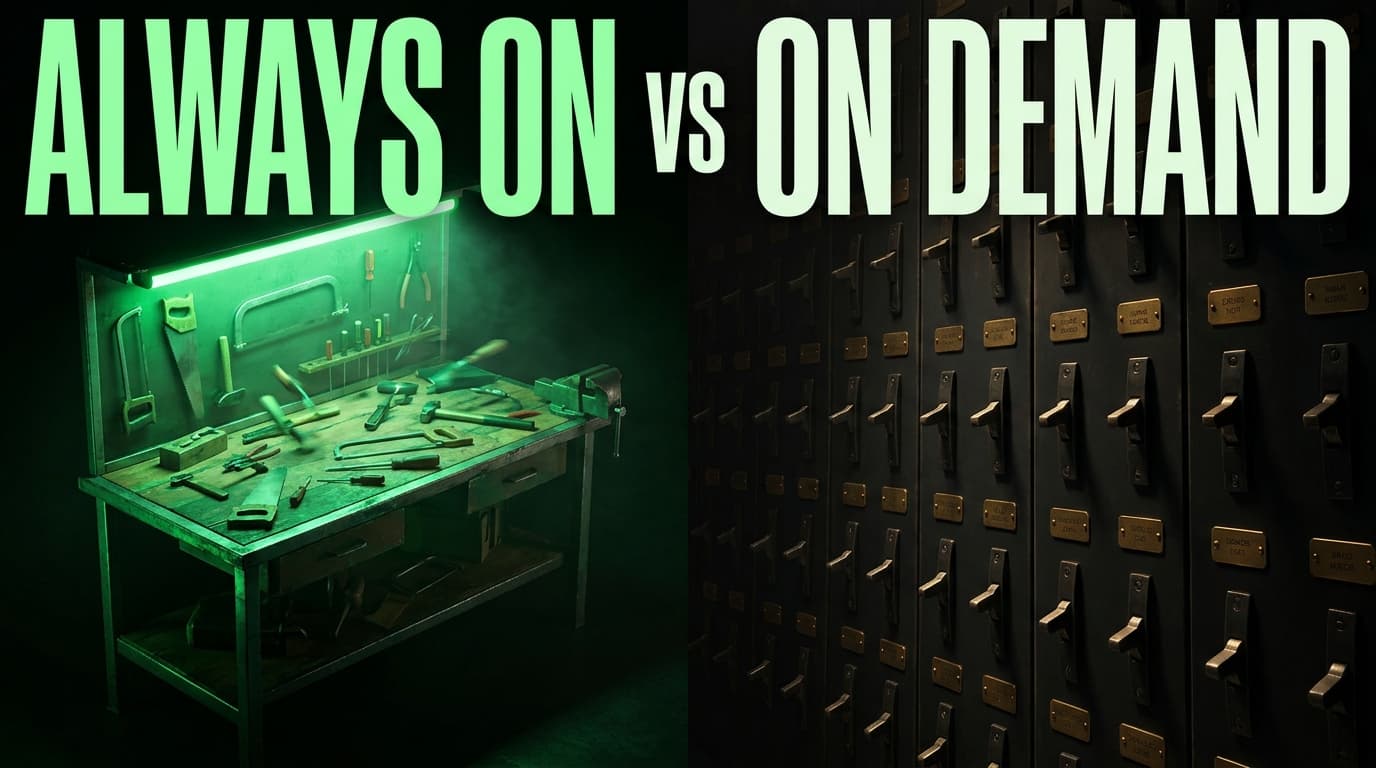
Compound engineering vs Superpowers: what each one installs
Both Claude Code plugins installed and measured: 14 skills against 33, one SessionStart hook against none, and the six skills that collide when you run both.