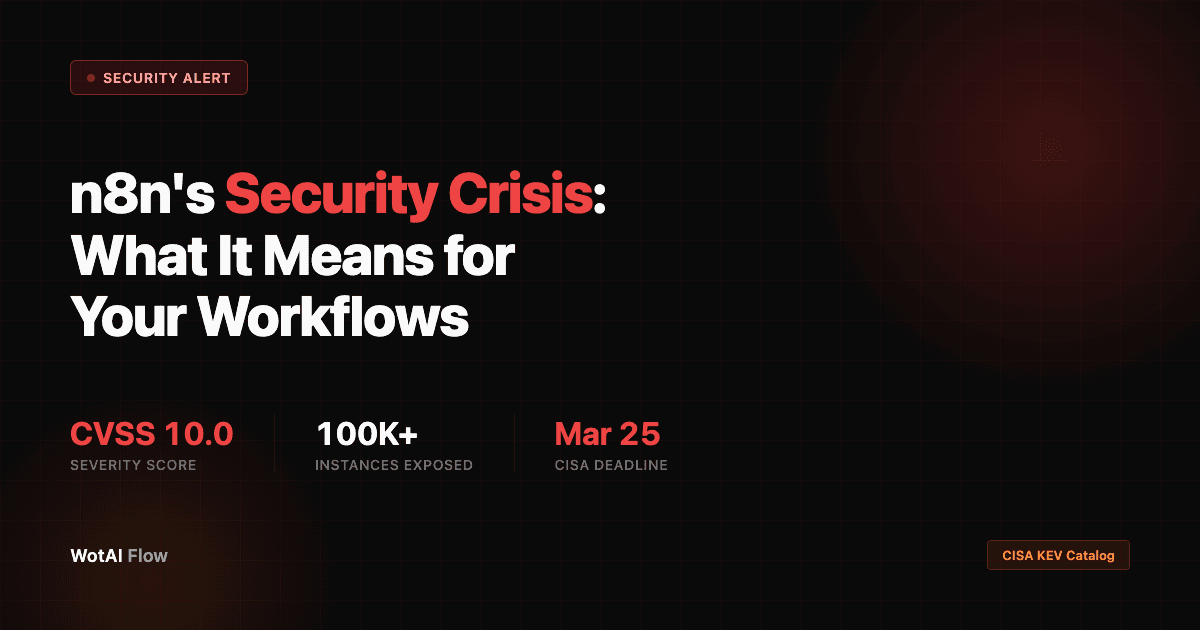
Two critical vulnerabilities. A CVSS score of 10.0. Over 100,000 self-hosted instances exposed. And a CISA compliance deadline of March 25, 2026.
If you run n8n, this is the most important security event in the platform's history. Here's what happened, what it means for your workflows, and what to do about it.
What Happened
Since late 2025, security researchers have disclosed a series of critical vulnerabilities in n8n's self-hosted platform:
CVE-2026-21858 ("Ni8mare") – CVSS 10.0 An unauthenticated remote code execution flaw in n8n's webhook handlers. Attackers exploit Content-Type confusion in form submission triggers to read local files, steal secrets, forge admin sessions, and execute arbitrary code. No login required. Horizon3.ai published a full technical breakdown, and CISA added it to the Known Exploited Vulnerabilities (KEV) catalog.
CVE-2025-68613 – CVSS 9.9 An expression injection vulnerability that lets authenticated users run code with n8n process privileges. CISA confirmed active exploitation in the wild, with roughly 24,700 instances still exposed as of March 2026.
Stored XSS in Shared Credentials A lower-severity but compounding issue: OAuth2 credential sharing could enable account takeover. Fixed in n8n v2.6.4 (February 6, 2026).
Government agencies worldwide have responded. Australia's Cyber.gov.au, Canada's Cyber Centre, and CISA have all issued advisories. CISA's deadline for federal agencies to patch is March 25, 2026 – two days from now.
Why This Matters More Than a Typical CVE
Most software vulnerabilities are abstract. These are not.
Your n8n instance likely holds API keys for every service it connects to: your CRM, your email provider, your payment processor, your database. A compromised n8n instance doesn't just affect n8n. It gives attackers a skeleton key to your entire integration stack.
Think about what flows through your workflows:
- Customer data from your CRM
- Payment credentials from Stripe or PayPal
- Database connection strings
- Email service API keys
- Webhook secrets from third-party services
A single exploited vulnerability means potential access to all of it.
The Self-Hosted Security Burden
Self-hosting n8n gives you control. It also gives you the full security burden.
When a critical CVE drops, the clock starts ticking. You need to:
- Monitor for advisories across CISA, NVD, n8n's community forum, and security outlets
- Evaluate the impact on your specific version and configuration
- Test the patch in a staging environment before deploying
- Apply the update across all instances, potentially during business hours
- Rotate credentials for any services that may have been exposed
- Audit logs for signs of exploitation during the exposure window
Many organizations run n8n behind minimal security: no WAF, default configurations, internet-facing instances with no IP restrictions. The Ni8mare vulnerability specifically targets these setups because it requires zero authentication.
This isn't a one-time problem. n8n has disclosed multiple critical vulnerabilities in the past three months alone. Self-hosted means you own every patching cycle, forever.
Managed vs. Self-Hosted: The Security Argument
The managed vs. self-hosted debate used to be about convenience and cost. After this year's CVE disclosures, it's increasingly about security.
With a managed platform:
- Patching happens automatically. No monitoring, no testing, no deployment windows. The provider applies security updates across all instances.
- Network isolation is built in. Instances aren't internet-facing by default. Access controls and firewalls are configured at the infrastructure level.
- Credential management is centralized. Secrets are stored in encrypted vaults, not in environment variables on a VPS you provisioned two years ago.
- Monitoring is continuous. Anomaly detection and audit logging run 24/7 without any setup on your end.
With self-hosted n8n, you get flexibility but inherit the full security operations burden. For teams without dedicated security staff, that burden is increasingly hard to justify.
CISA isn't just flagging these vulnerabilities. They're setting hard deadlines. That's not a suggestion – it's an enforcement signal that automation platform security is now a compliance issue.
What to Do Right Now
Whether you stay self-hosted or move to managed, take these steps today:
1. Check Your n8n Version
The critical patches are in n8n v2.10.1, v2.9.3, and v1.123.22. If you're running anything older, you're exposed. Update immediately.
2. Audit Your Instance Exposure
Is your n8n instance internet-facing? Can it be reached without a VPN or IP whitelist? If yes, fix that before anything else. The Ni8mare exploit targets unauthenticated endpoints.
3. Rotate Credentials
Assume the worst. Rotate API keys, database passwords, and webhook secrets for every service connected to your n8n workflows. Yes, all of them.
4. Review Workflow Permissions
CVE-2025-68613 requires authentication but allows privilege escalation. Audit which users and service accounts have workflow editing permissions. Remove any that don't strictly need them.
5. Evaluate Your Long-Term Security Posture
This won't be the last critical CVE. Ask yourself honestly: does your team have the capacity to monitor, evaluate, test, and deploy security patches for every piece of infrastructure you self-host?
If the answer is no, it's time to consider a managed alternative that handles security operations for you.
The Bigger Picture
This security crisis is a turning point for workflow automation. Platforms that handle sensitive data and connect to critical business systems need to meet a higher security bar. CISA's involvement signals that automation infrastructure is being held to the same standard as any other enterprise software.
For n8n users, the immediate priority is patching and credential rotation. But the strategic question is whether your team should be spending cycles on infrastructure security or on building the automations that drive your business.
WotAI Flow runs n8n workflows on managed infrastructure with automatic patching, network isolation, and centralized credential management. You focus on building workflows. We handle the security.
Try WotAI Flow free for 14 days – no credit card required.
Frequently Asked Questions
What is CVE-2026-21858, the "Ni8mare" vulnerability?
CVE-2026-21858 is a critical (CVSS 10.0) unauthenticated remote code execution flaw in n8n's webhook handlers. It allows attackers to read files, steal secrets, and execute arbitrary code on self-hosted instances without any login credentials.
How many n8n instances are affected?
Security researchers estimate roughly 100,000 self-hosted n8n instances are exposed to CVE-2026-21858, and approximately 24,700 remain vulnerable to CVE-2025-68613 as of March 2026.
What is the CISA deadline for patching n8n?
CISA added both CVEs to its Known Exploited Vulnerabilities (KEV) catalog with a compliance deadline of March 25, 2026 for federal agencies. Private organizations should treat this as an urgent patching signal.
Does this affect managed n8n platforms like WotAI Flow?
Managed platforms handle patching automatically at the infrastructure level. WotAI Flow applies security updates across all instances without requiring action from users, and instances are network-isolated by default.
What should I do if I think my n8n instance was compromised?
Immediately rotate all credentials connected to your workflows (API keys, database passwords, webhook secrets). Review n8n logs for unusual activity, especially around form submission endpoints. Update to the latest patched version and consider moving to a managed platform.
Stop guessing. Score your first workflow.
Score one workflow in about five minutes. Nine questions, a grade, and the specific gap holding it back - no call required.
Related Posts
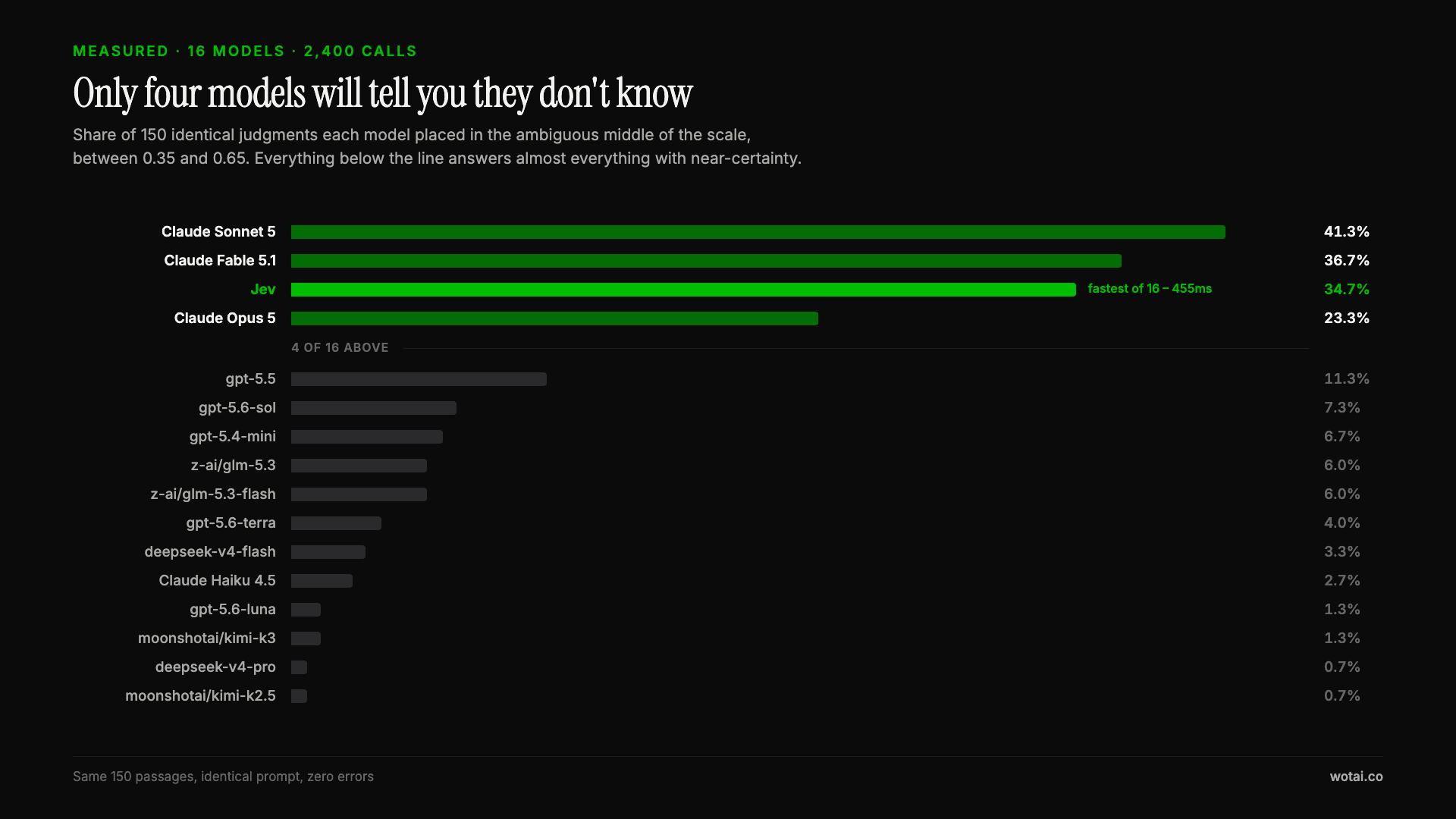
Jev is the only sub-second model that will tell you it doesn't know
Sixteen models on the same 150 passages, plus two more tasks. Only four of the sixteen will say they are unsure, and Jev is the only one of those four that answers in under a second.
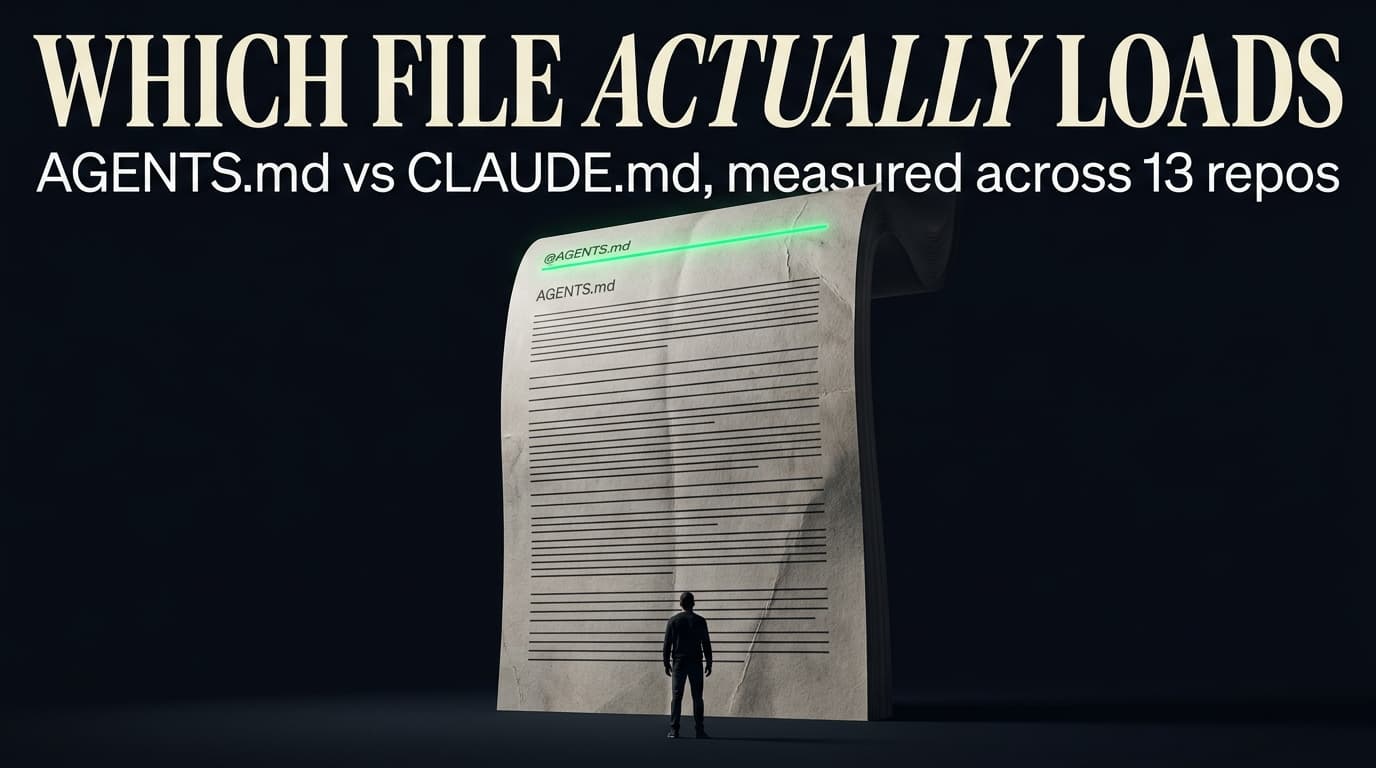
AGENTS.md vs CLAUDE.md: which file your agent actually reads
Both files in one repo, measured: load order, token cost, and which one wins when they disagree. Every guide explains the difference; this one runs the test.

Compound engineering vs Superpowers: what each one installs
Both Claude Code plugins installed and measured: 14 skills against 33, one SessionStart hook against none, and the six skills that collide when you run both.