Last updated: August 7, 2026
TL;DR
Every invoice automation runs the same five steps, whether it costs nothing or six figures: capture, extract, match, approve, sync. Knowing that is what turns a sales call into a short conversation. The step that fails is extraction, and it fails on exactly the invoices you care about: the handwritten line item, the PDF a two-person supplier built in Word, the one scanned at an angle. Plan for 90 to 95 percent accuracy and design the exception path first. Prices run from $0 to $89 per user per month, and for a lot of small businesses the honest answer is that some of this work should be deleted rather than automated.
The five steps in every invoice automation
Every vendor sells the same pipeline with a different name on it. Once you can name the five steps yourself, you stop listening to feature lists and start asking which steps the product actually covers.
Invoices land somewhere: an inbox, a portal, a stack of paper that gets scanned. That is capture. Then invoice OCR and an AI model read the document and pull out the fields that matter, vendor and date and line items and total, which is extract. Match compares what you were billed against what you ordered, and against what actually showed up if you are doing three-way matching. Approve routes the thing to whoever needs to say yes, usually with a dollar threshold deciding whether that is a person or a rule. And sync posts the approved data into your accounting system and sends the money.
Most small businesses genuinely need capture, extract, and sync. Match and approve exist because big companies have purchase orders and approval hierarchies. If you do not issue POs, three-way matching is a feature you will pay for and never switch on.
Where invoice automation actually breaks
Not in that pipeline. In extraction.
Accuracy is a range, and the range you get is not the one in the pitch. Vendors quote numbers from clean, typed, machine-generated PDFs sent by large suppliers. Your invoice mix has a photo from a subcontractor, a spreadsheet exported to PDF with merged cells, and a total written in pen on a delivery slip. Those produce the errors that hurt, because a bad extraction in accounts payable is not a crash. It is a wrong number sitting quietly in your books.
Which makes the exception queue the actual product. A tool that gets 95 percent right still hands you 5 percent to fix. On 400 invoices a month, that is 20 documents somebody has to catch and correct. If fixing one takes longer than typing the invoice from scratch would have, you have bought negative time. When you take a demo, ask to see the exception queue. Not the happy path, the queue.
Line items are their own problem. Header data, meaning vendor and date and total, is close to solved. Per-row data with quantities and unit prices and GL codes is much harder, and it is where the price gap between tools lives. Hubdoc is free with Xero and captures header data. Dext costs about $25 a month and reads line items. If you need per-line cost coding, the free tool will not get you there, and discovering that after you have migrated is an expensive lesson.
One more, and it is the one people find out the hard way: automation inherits your vendors' chaos. A supplier who changes their template, double-sends, or bills against the wrong PO will keep doing all of that, just faster now. The businesses that get the most out of this fixed how invoices arrive before they bought anything.
What invoice automation costs in 2026
Real prices, checked this month, for the tools a small business actually ends up comparing.
| Tool | Price | What you get |
|---|---|---|
| Ramp (Free) | $0 per user/month | Invoice OCR, approval workflows, fraud checks, bill pay by ACH, card, check, wire |
| Ramp (Plus) | $15 per user/month plus a platform fee | Adds batch payments, AI approval recommendations, line-item auto-coding |
| Hubdoc | Free with Xero Standard or Premium | Header-level document capture, Xero only |
| Dext | About $25/month for roughly 250 documents, 5 users | Line-item extraction, multi-platform |
| BILL Essentials | $49 per user/month | Bill entry, approvals, ACH and card payments, CSV accounting sync |
| BILL Team | $65 per user/month | Adds two-way sync with QuickBooks Online and Xero |
| BILL Corporate | $89 per user/month | Adds NetSuite and Sage Intacct sync, POs, two-way matching |
| QuickBooks Online | Simple Start $38, Essentials $85, Plus $140 per month | Bill management starts at Essentials; receipt capture has soft volume limits |
Two lines in that table matter more than the others.
Per-user pricing is where the budget goes. Five people on BILL Corporate is $445 a month, $5,340 a year, and that is before QuickBooks. The same five people on Ramp's free tier pay nothing for the same core steps. Per-user pricing is reasonable when three people touch invoices and brutal when everyone approves their own department's bills.
And QuickBooks Online raised prices on August 1, 2026, between 13 percent on Essentials and 70 percent on Advanced. If your plan involves moving from Simple Start up to Essentials to get bill management, price that at $85, not at whatever you remember paying.
Under about 50 documents a month, the receipt capture already sitting in your accounting software plus one rule about how invoices arrive covers most of the pain for nothing. Paid tools start earning their keep somewhere around 100 to 200 invoices a month, earlier if line-item coding is what is actually slowing you down.
Three paths, and how to pick
Native first. Whatever your accounting software already does. QuickBooks and Xero both capture receipts and bills, and Xero throws in Hubdoc at no extra cost. Nothing extra to buy, very little to break, and if you are under 50 invoices a month this is where you should stop reading and go turn it on.
A bundled AP platform. Ramp, BILL, one of the others. You get the whole pipeline, real support, and an audit trail, and in exchange you accept a subscription and somebody else's opinion about how your workflow should go. For most businesses past 100 invoices a month this is the right answer. Compare them on exception handling and how deep the sync goes with your accounting system. Not on the feature grid, which is designed to be won.
Build it. An intake inbox, an extraction API, and something like n8n will cover capture, extract, and sync if your process is genuinely unusual or your vendor mix defeats the products. This is very achievable now. It is also a system you own forever, including the week a supplier changes their template and extraction quietly gets worse without telling you. Build when the process itself is your advantage, not to dodge a subscription.
Can you just use Claude or ChatGPT?
For a small enough pile, yes. Most guides on this topic will not say that out loud.
Drop an invoice PDF into Claude or ChatGPT, ask for vendor and date and line items and total back as structured data, and you will get a good answer. The current models read documents genuinely well, including the messy layouts that used to defeat OCR outright. If you are handling five to twenty invoices a month, that plus typing them into your accounting software is a perfectly defensible setup that costs you nothing. Nobody should be selling you a platform to replace twenty minutes of work a month.
What you are missing is not the reading. It is everything wrapped around the reading.
Something still has to put the file in front of the model, and right now that something is you. Every conversation starts cold, so the same invoice can come back shaped differently on a different day, where a pipeline would pin the schema. Nothing is checking whether you already paid this one last month, and duplicate payments are one of the specific losses these tools exist to stop. There is no record of who approved what, which is fine until someone asks. And the data still has to get into your books by hand at the end of it.
What connecting Google Drive, Dropbox, or Box actually changes
Both Claude and ChatGPT connect to cloud storage, and that closes exactly one of those gaps. It happens to be the one worth closing.
Invoices land in a folder the way they already do, and instead of uploading files one at a time you ask questions across the whole folder. That quietly changes the job from a per-document chore into a monthly batch review: point the model at the folder, ask for every invoice pulled into a table, scan it. If you are somewhere around twenty to fifty invoices a month, that is a genuinely good workflow and it costs you almost nothing.
What it does not change is the shape of the thing. A connector gives the model access. Access is not automation.
Nothing triggers, because connectors pull when you ask rather than firing when a file arrives, so you are still the scheduler and it runs when you remember. Nothing remembers either, since every session starts cold, so asking twice gets you two independent answers and nothing anywhere knows which invoices you already dealt with. And nothing writes back. The model can read your Drive all day and still cannot post a bill into QuickBooks, so the last mile stays yours.
Access versus triggers, state, and write-back. That is the actual line between a connected chat account and a pipeline, and it is worth knowing which side your volume puts you on before you pay for anything.
What a scheduled agent task changes
Claude Desktop and Codex will both run a task on a schedule without you sitting there. That closes the trigger gap, and it is the moment this stops being a chat window and starts being a system.
Picture the working version. Every weekday at 8am it checks the invoice folder for anything new, pulls vendor and date and total out of each one, appends them to a sheet, and flags anything over $5,000 or from a vendor it has not seen before. That is genuinely useful, it runs whether or not you remember it, and for a lot of small operators it covers the part of an AP platform they actually touch.
There are two kinds of scheduled task though, and picking wrong quietly breaks this. Claude Desktop's Routines page makes either a local task or a remote routine.
A local task runs on your own machine, sees your actual files, and can fire as often as every minute. It also only runs while the app is open and the computer is awake. Sleep through 9am and that run is simply skipped; when you wake the machine you get one catch-up run for the most recently missed time and everything older is thrown away. So a task you set for 9am can end up running at 11pm, against a whole day of invoices, because somebody opened a laptop. Anthropic says as much in their own docs and suggests writing the guardrail into the prompt, something like "only process invoices that came in today."
A remote routine runs in the cloud whether your computer is on or not. The trade is a one-hour minimum interval and no access to local files, because it works through connectors instead.
For invoices that difference is basically the whole decision. If your invoices land in Google Drive or Dropbox or Box, the remote routine is the right shape, since cloud storage is exactly what it can see and hourly is far more precision than an invoice has ever needed. If your invoices live in a folder on one person's laptop, a local task is your only option, and your automation now depends on that laptop being open at the right moment. That is a thin foundation for the function that pays your suppliers.
And one setup detail that will bite on the first unattended run: a task that hits a tool it lacks permission for stalls instead of carrying on. Run it by hand once, approve everything it asks for, set those to always allow, and only then leave it alone.
Two things then decide whether it survives contact with reality.
The first is that you have to build the "already did this one" record yourself. Scheduled tasks fire on a clock, not on a file arriving, which for invoices does not matter at all. What matters is that the naive version happily reprocesses the entire folder every single morning, so you need somewhere to mark a document as handled and you need the task to check that mark before it does anything. A paid product hands you this and never brings it up. Build it yourself and it is the first thing that bites.
The second is that it can read and record, but it cannot move money. This is worth being exact about, because it explains the whole pricing table above. Extraction is close to a commodity now, which is why a free tier can afford to give it away. What BILL and Ramp are actually selling is payment rails and the compliance wrapped around them: ACH and virtual card execution, checking vendor bank details are real, blocking a duplicate payment, and keeping an approval record that holds up when somebody asks who authorized this eighteen months ago. No scheduled agent gives you any of that, and honestly you should not want it to.
There is also a failure mode a manual process does not have. An unattended task that quietly misreads a vendor's new template does not stop and tell you. It keeps going, writing wrong numbers into your sheet, until a person happens to notice. So whatever you build, the first addition is not more automation. It is a weekly look at what the thing actually did.
Which lands here: a scheduled task is the right answer for capture, extract, log, and flag. An AP platform is the right answer once moving money and holding an audit trail are the actual job. Most small businesses need the first one and have been sold the second.
Worth naming the privacy piece too. Invoices carry vendor bank details, account numbers, sometimes personal information. Pasting that into a consumer chat account is a different risk posture than using a tool that hands you a data processing agreement. Check your provider's business terms before the experiment quietly turns into the process.
The version that scales is the third path above: call the model through its API from inside a workflow, so the workflow owns intake, schema, deduplication, logging, and the accounting sync, and the model only does the part it is good at. That is a real system. It is also the same architecture the paid tools are built on, which is the honest reason building it yourself is a choice about ownership rather than a clever way to dodge a subscription.
What not to automate
No vendor writing about this topic will publish this section, which is exactly why it is here.
Invoices you get fewer than five of a month. Twelve a year from one supplier is about twenty minutes of annual work, and any setup and maintenance you do will cost more than that.
Anything where the human is the control rather than the bottleneck. Final approval on large payments is the clean example. Route it automatically, sure. But the approval itself is the moment a person confirms the money is real, and automating that decision away removes the control that catches invoice fraud, which is often the exact thing the automation was sold to you as preventing.
Vendors you are always arguing with. If half their invoices need a phone call, automating that relationship just encodes the argument into a workflow.
And the ones that should be deleted instead. A reconciliation report nobody reads does not need an agent, it needs someone to stop making it. The three-question test from our guide to AI agents for small business is the same filter here: real hours over a year, breaks when one person is out, and two people describing the rules the same way. Invoice work usually clears the first two and fails the third, which is the whole argument for standardizing before you buy.
A 30-day sequence that works
Week 1, count. Invoices per month, number of vendors, formats, and how many need a correction today. Every quote you get before you have these numbers is unanchored.
Week 2, standardize intake. One email address for invoices, and tell your vendors to use it. This costs nothing and removes more pain than people expect.
Week 3, trial on your worst documents. Not the vendor's clean samples. Your actual bad ones, through two tools, and time how long fixing an exception takes in each.
Week 4, decide on the exception rate. Pick whichever tool handled your bad documents best, not whichever claimed the highest accuracy on clean ones. Then run it alongside the manual process for one full cycle before you switch anything off.
Frequently asked questions
How do I automate invoice processing? Route every invoice to one digital intake point, run it through an AI extraction tool that pulls vendor, date, and totals, set approval rules by dollar threshold, and sync approved data to your accounting system. Start with the capture and extract steps; matching and approval routing only pay off at higher volume.
How much does invoice automation cost? From $0 to about $89 per user per month. Ramp includes AP automation on its free tier. Dext runs about $25 a month for roughly 250 documents. BILL charges $49 to $89 per user per month depending on tier. Per-user pricing dominates the total once several people approve invoices.
Is invoice automation worth it for a small business? Below roughly 50 invoices a month, usually not as a separate purchase. The receipt capture already in QuickBooks or Xero plus a single intake email covers most of it. Paid tools start earning their cost around 100 to 200 invoices a month, or sooner if you need line-item coding.
What is invoice OCR? Invoice OCR converts an invoice image or PDF into machine-readable text, which an AI model then maps to structured fields such as vendor, invoice number, and total. Modern tools combine OCR with a trained model, which is why they handle varied layouts far better than OCR alone did.
How accurate is AI invoice processing? Expect 90 to 95 percent on a realistic mix of documents, and higher on clean machine-generated PDFs. Accuracy drops on scans, handwriting, and line-item extraction. Plan for an exception queue rather than treating any quoted accuracy figure as the number you will see.
Does QuickBooks automate invoice processing? Partly. QuickBooks Online captures receipts and bills, with bill management starting on the Essentials plan at $85 a month. Receipt capture carries soft volume limits, so businesses scanning more than about 50 documents a month typically add a dedicated tool alongside it.
What is three-way matching? Three-way matching compares the invoice, the purchase order, and the receiving record before approving payment, confirming you were billed for what you ordered and actually received. It only applies if you issue purchase orders. Businesses without POs should not pay for it.
Can ChatGPT or Claude process my invoices? Yes, and connecting Google Drive, Dropbox, or Box lets you work across a whole folder instead of uploading files one by one, which suits a monthly batch review. What you still lack is a trigger, memory between sessions, and any write path into your accounting software. Below roughly 50 invoices a month that trade is often worth it.
Can a scheduled Claude Desktop or Codex task replace invoice automation software? For capture, extraction, logging, and flagging, yes. It cannot execute payments, verify vendor bank details, block duplicates, or hold an approval record, which is what AP platforms actually charge for. Use a remote routine if invoices land in cloud storage; a local task only runs while the machine is awake and the app is open.
Do Claude Desktop scheduled tasks run when my computer is asleep? Local tasks do not. They only fire while Claude Desktop is open and the machine is awake, and a run missed during sleep is skipped, with one catch-up run on wake for the most recent miss. Remote routines do run with the computer off, at a one-hour minimum interval, but reach cloud storage rather than local files.
What should I not automate in accounts payable? Final payment approval on large amounts, vendors whose invoices routinely need a phone call, and any invoice type you receive fewer than five of a month. Automating approval removes the human control that catches invoice fraud, which is the risk automation is often sold as reducing.
How long does invoice automation take to set up? A native setup inside your accounting software takes an afternoon. A bundled AP platform takes two to four weeks including vendor sync and approval rules. A custom build takes longer and never fully ends, because extraction quality needs monitoring as vendor templates change.
The businesses that get real value out of this are not the ones who bought the most capable tool. They counted their invoices first, fixed how the documents arrive, and then bought the smallest thing that could handle their worst ones.
Working through this in your own business? The WotAI community is where operators compare what actually held up: https://skool.com/wotai
Stop guessing. Score your first workflow.
Score one workflow in about five minutes. Nine questions, a grade, and the specific gap holding it back - no call required.
Related Posts
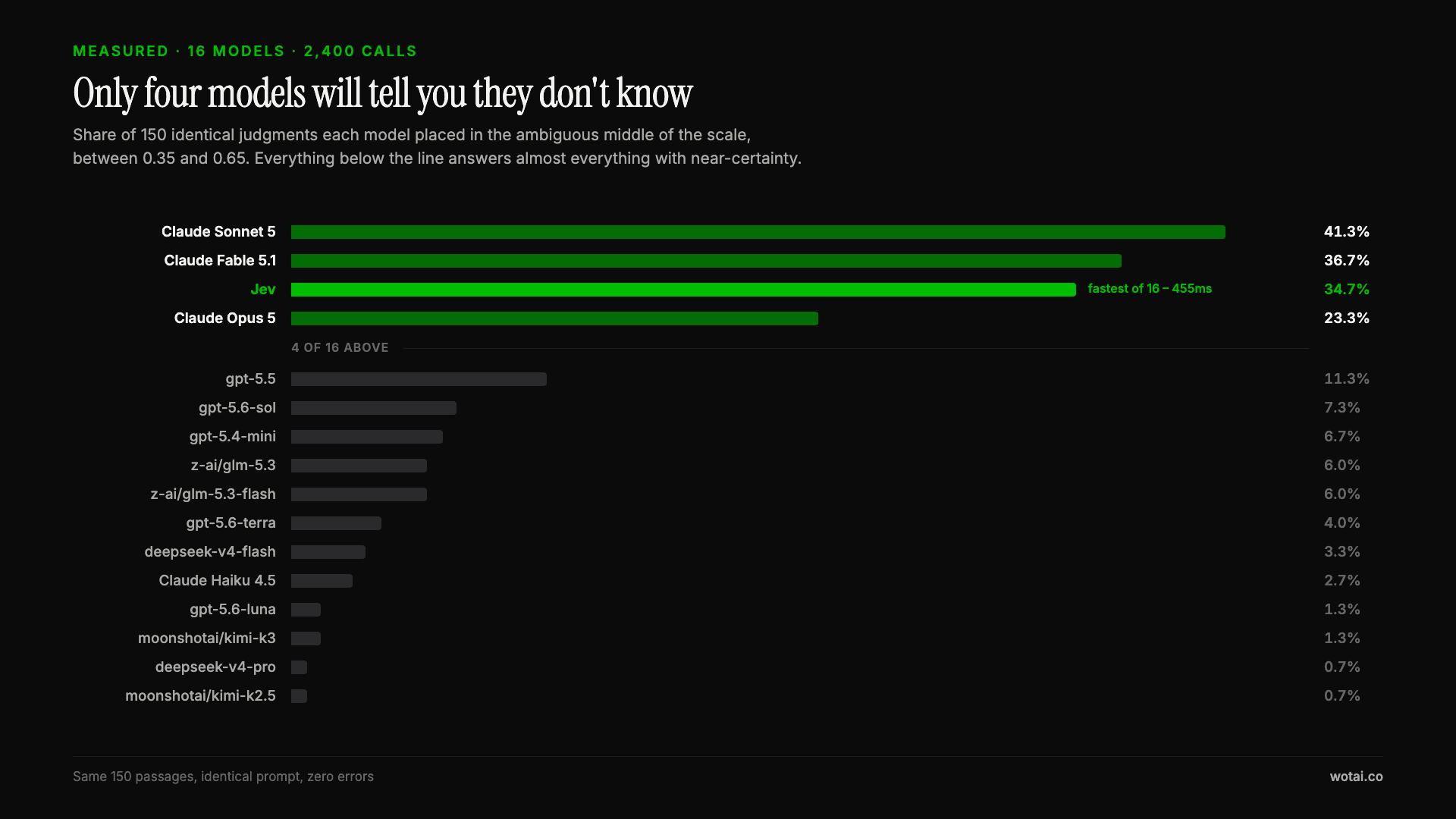
Jev is the only sub-second model that will tell you it doesn't know
Sixteen models on the same 150 passages, plus two more tasks. Only four of the sixteen will say they are unsure, and Jev is the only one of those four that answers in under a second.
AGENTS.md vs CLAUDE.md: which file your agent actually reads
Both files in one repo, measured: load order, token cost, and which one wins when they disagree. Every guide explains the difference; this one runs the test.
Compound engineering vs Superpowers: what each one installs
Both Claude Code plugins installed and measured: 14 skills against 33, one SessionStart hook against none, and the six skills that collide when you run both.