Last updated: August 18, 2026
TL;DR
Pick the workflow you would fix first, then score it on five things: how often it happens, how writable the steps are, how much it interrupts, how costly a small mistake is, and how much license or liability weight it carries. Five points each, 25 total. Twenty or more with nothing under a 3 and you have found your starting point. Either way, your lowest check tells you what to shore up first.
What an AI readiness checklist actually checks
An AI readiness checklist is a short set of pass-or-fail tests that tell you whether a piece of work is ready to automate before you commit budget to it. Readiness gets assessed at two levels, and both of them earn their place.
Organization readiness asks whether the company can support AI at scale: data foundations, infrastructure, talent, strategy, governance. Workflow readiness asks whether one particular process is a good first candidate. This guide is the second one, and it takes about five minutes.
Organization readiness and workflow readiness work together
The frameworks from Cisco, Microsoft, Avanade, and the big advisory firms are built for the program-level decision, and they are good at it. If you are standing up governance, planning a data platform, or mapping a multi-year roadmap, that is the assessment you want, and the six-pillar depth is precisely why it works.
Workflow readiness sits at a different moment in the same process. Every AI program, whatever the company size, eventually lands on a narrower question: which workflow do we actually do first? A 10-person shop and a 10,000-person division both hit it. The small business hits it with nobody to hand it to; the enterprise hits it with 40 candidates and a need to triage. The checks turn out to be the same either way.
So this is a complement, not a substitute. Score the organization to plan the program, score the workflow to pick the next build. The teams I would bet on run both, because a roadmap and an early shipped win make each other more credible.
The Federal Reserve's Small Business Credit Survey gives you a sense of how much room sits in that second question. It surveyed 6,525 firms with 1 to 499 employees between September and November 2025, and found that 46% already use AI, while just 7% of those call it fully integrated.
Where they went first says a lot: writing or marketing (83%), individual productivity (61%). Those are real wins and they are already in the bank. The bigger one still ahead is moving AI from something people use to something a workflow runs on, and that is a workflow-level call every single time.
The survey is also encouraging about what is in the way. Among firms already using AI, the top challenges are accuracy (46%) and adapting tools to meet business needs (43%). Among those planning to adopt, finding tools that fit the business (54%) leads by a mile. Both of those are fit questions, and fit is exactly what a workflow-level checklist settles early, before it gets expensive.
The five checks
Score one workflow: the one you would fix first if you only got one. Each check runs 1 to 5, and 5 always means more ready. Add them up for a score out of 25.
1. How often it happens
A few times a month is a 1. A few times a week is a 3. Many times a day is a 5.
Frequency multiplies everything else on the list. A workflow that runs twice a month can hurt quite a lot and still sit behind others in the queue, simply because it returns less at that volume. Frequency is what turns a small saving per run into a real one.
2. How writable the steps are
Every case different is a 1. A checklist covering about half is a 3. A checklist covering 90 percent of cases is a 5.
This is the check that tells you what kind of tool the job needs. If you can write the steps down, ordinary automation handles it and you end up with a simpler, cheaper system. If you cannot, the fix has a different shape, which the grid further down sorts out. Both answers are worth having.
Score the reality, not the intent. If a written procedure exists and everyone quietly works around it, score what people actually do.
3. How much it interrupts
Batched with nobody waiting is a 1. Picked up within a few hours is a 3. Real time with a customer waiting is a 5.
This one reads backwards to almost everyone, so let me say it flatly: the more a workflow interrupts, the more worth automating it is. The value of an interrupting task is not the minutes on the clock. It is the concentration it breaks and the customer left hanging. Automating it gives you both back, and neither one ever showed up on a time sheet.
4. How costly a small mistake is
Expensive to undo is a 1. Noticed and fixed within a day is a 3. A quick fix is a 5.
Anything you automate will eventually get something wrong, so the useful question is what that costs when it does. Work where mistakes surface fast and cost little is the best place to start, because that is where you build real capability at low stakes.
5. How much license or liability weight it carries
A licensed or regulated decision is a 1. A professional signing off before it goes out is a 2. Contractual commitments, a 3. Mostly internal with light review, a 4. Pure back-office mechanics, a 5.
This check can settle the whole thing by itself. A 2 or lower means the workflow stays with a person, no matter what the other four add up to. Work that carries a license carries it for good reasons, and the productive move is to aim the first build at the workflow sitting next to it.
How to score it
Add the five up for a score out of 25, then work through them in this order. The order matters, because the liability check decides more than any other.
Start with liability. If check five came in at 2 or lower, this one stays with a person, and you can stop reading your own scores there. A workflow sitting at 23 out of 25 that a licensed professional has to sign off on still stays with the professional.
Then the floor. Under 15 total and this is not the workflow to start with. That is direction, not a failing grade.
Then the strong case: 20 or more, nothing below a 3 on any single check, and a workflow shape automation actually fits. That is your starting point.
Everything in between is a good candidate with one thing to shore up first. Go find your lowest score. That number is more useful than the total, because it names the work instead of just grading it.
What kind of fix the workflow needs
The total tells you whether to move. Two of the checks together tell you what to build. Cross how writable the steps are against how consistently the input shows up:
| Input arrives the same way | Input arrives however it arrives | |
|---|---|---|
| Steps are writable | Plain automation. No model needed. | AI plus automation. The model reads the input, automation does the rest. |
| Steps are not writable | AI assists a human. Drafts, summaries, suggestions, with a person still deciding. | Keep it with a person for now. |
"Arrives the same way" covers input that varies in predictable ways, too. A form with different values in the same fields is still consistent. Documents, voicemails, and free text that turn up in whatever shape they please are not.
The top-left box is worth pausing on, because it is the happiest result on the grid. Same information, same format, steps you can write down: that is a well-understood automation problem with mature, inexpensive tooling, and it ships faster than anything with a model in it.
Why a clear verdict either way is the point
A recommendation is worth more when it could have gone the other way. That is what makes a green light mean something, and it is why this checklist carries a liability veto and a floor.
The data backs that up, and it points somewhere hopeful. Gartner reported in February 2025 that 63% of organizations "either do not have or are unsure if they have" the data management practices AI needs, from a survey of 1,203 data management leaders run in July 2024. The same release predicted that through 2026, organizations will abandon 60% of AI projects unsupported by AI-ready data. That final clause carries most of the sentence, and it is the encouraging part: the projects at risk are the ones where nobody pinned down the inputs and the steps.
That is a solvable problem, and it is cheapest to solve early. These five checks surface it in about five minutes, well before anyone has committed a budget.
Which is why a total under 15 is genuinely good news. It usually means one specific thing is missing, most often that the steps are not written down yet, and it points you at either a better-suited workflow or a short piece of prep that makes this one work. We made a version of that case in our guide to what an AI receptionist actually costs a small business, and check five does the same job in regulated work, which the errors and omissions section of our guide to AI for insurance agents gets into.
Run it on a real workflow
The checklist works fine on paper. If you would rather have it scored for you, we built the interactive AI readiness assessment. Nine questions, about five minutes, and you get a grade, your weakest check named in plain language, and the one number worth writing down before and after.
Nobody calls you, and it gives you a straight answer either way.
Frequently asked questions
How to measure AI readiness?
Measure it at two levels. Organization readiness scores data, infrastructure, talent, strategy, and governance to plan a program. Workflow readiness scores one process on five checks: frequency, how writable the steps are, interruption cost, error cost, and liability weight. Each scores 1 to 5, for 25 points.
What are the five pillars of AI readiness?
The widely used five are data foundations, strategy and leadership, technology infrastructure, people and culture, and governance and risk. They are the right frame for a program-level decision. Alongside them, five workflow-level checks answer the narrower question of which process to automate first.
What are the three pillars of AI readiness?
The three-pillar version groups the model into people, process, and technology. It is a clear way to assign ownership across teams and to communicate a plan upward. To choose a specific first build, scoring the individual workflow gets you there faster.
What are the 7 pillars of AI?
The count varies by framework, since firms split data and governance into different categories. Several of them work well. The practical questions are what decision the framework is built to support, and how much detail it asks you to work in.
What are the big 5 in AI?
That phrase usually points at the largest AI providers rather than at readiness. Provider choice matters less than whether the workflow you aim it at is a good fit, which is what the five checks here measure.
What is the 30% rule in AI?
We stick to figures we can trace to a primary source, and this one has none: it turns up on aggregator sites with several different meanings. Where solid numbers exist they are worth quoting in full, the way Gartner's prediction is above, which applies only to projects unsupported by AI-ready data.
What if my result says this workflow stays with a person?
Then the checklist did its job and pointed the first build somewhere better. A low score usually reflects one weak check rather than a poor workflow, and most often that check is the steps not being written down yet. Shore that up, score it again, and it is often a strong candidate next quarter.
Do I need clean data or a defined use case before I start?
No. You need one workflow you would actually fix. Data quality and use-case definition are what the checklist measures, not what it asks of you up front. Turning up with a specific costly workflow in mind is the only preparation that helps.
How long should an AI readiness assessment take?
For one workflow, about five minutes. Organization-wide assessments run weeks to a quarter because they score governance, infrastructure, and talent across departments, which is the right depth for a program decision. For choosing the next build, the short version answers it.
Stop guessing. Score your first workflow.
Score one workflow in about five minutes. Nine questions, a grade, and the specific gap holding it back - no call required.
Related Posts
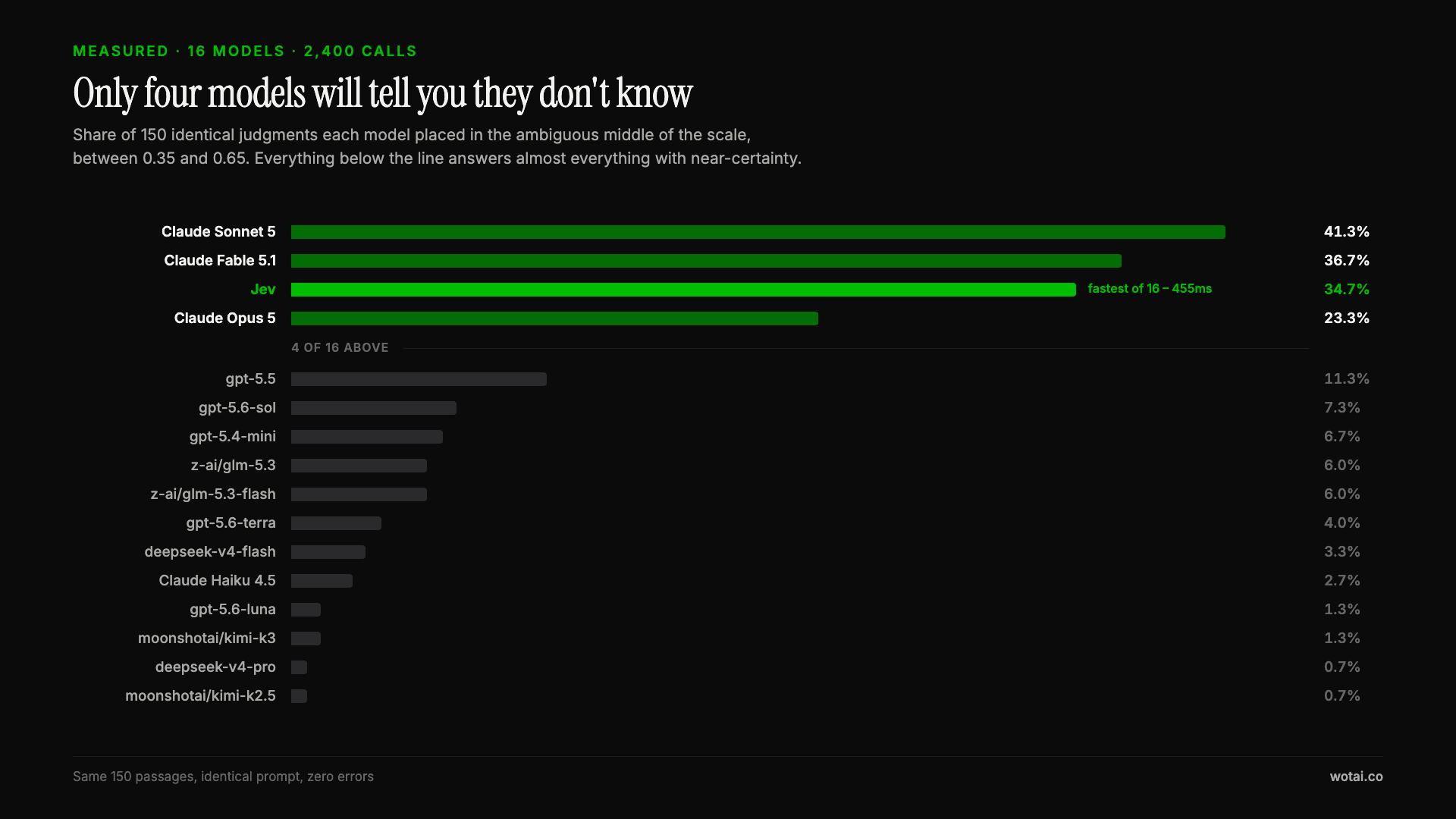
Jev is the only sub-second model that will tell you it doesn't know
Sixteen models on the same 150 passages, plus two more tasks. Only four of the sixteen will say they are unsure, and Jev is the only one of those four that answers in under a second.
AGENTS.md vs CLAUDE.md: which file your agent actually reads
Both files in one repo, measured: load order, token cost, and which one wins when they disagree. Every guide explains the difference; this one runs the test.
Compound engineering vs Superpowers: what each one installs
Both Claude Code plugins installed and measured: 14 skills against 33, one SessionStart hook against none, and the six skills that collide when you run both.